Monday, February 6, 2012

Caffeine: fairy-tale musical

For fans of syrupy love-themed Korean dramas, your dream musical is here once again.


Set in an intimate 359-seat hall, packed with humor and armed with a charismatic cast, “Caffeine” is set for another successful run on its hands, its third in two years.

Odd beverage-themed analogies, overly quick narrative jumps and forgettable opening numbers notwithstanding, the work makes it to the end in one piece, thanks to the easy-to-understand plot and the onstage couple’s inspired acting, singing and chemistry. The result is a light-hearted movie-like spectacle, an entertaining experience to be sure but without lasting impact.

“Caffeine” starts with Kim Se-jin, alternated by Yoon Gong-joo and Kim Ji-hyun, a 30-something female barista unlucky in love ― “the perennial second girl from the end,” or the last fling before the guys get married to someone else ― who is again turned down by a boyfriend. She avoids facing the music by working 15 hours a day, devoted only to work and sleep ― and nothing else. When her boss tries to spice up the joint by serving wine and thus hiring a handsome sommelier Kang Ji-min (played by Kim San-ho and Jung Sang-hoon), Se-jin becomes fixated on protecting her territory.

When Ji-min tampers with her most cherished property, her blackboard writings about the different interpretations of love, she waits for the moment to avenge this wrongdoing. As their shifts do not overlap, the sommelier decides to pull a prank; he shows up during her working hours and seduces her under a fictitious identity Jung-min. When she storms into the cafe during his shift the next day to confront the real Ji-min, he panics and disguises himself. He further develops his joke by becoming her confidant, advising her on a dating strategy with his other self.

Predictably, they fall in love; she falls right into the trap. When his deception is revealed, they briefly part ways. But the sorrow lasts about five minutes before they reunite for the final duet and the curtain call.

This sort of leap within the main plot is too choppy, which is ultimately the biggest problem of “Caffeine.” It is hardly a natural progression, for instance, that Ji-min would go to such lengths to avoid the confrontation with Se-jin because he would not know the great personal significance the blackboard has for her. The audience seemed perfectly happy to overlook these mistakes for the sake of fast-paced entertainment.

The loose chain of events comes as a surprise for a piece of work by local musical theater stars, lyricist Seong Jae-joon and composer Kim Hye-in. Seong also served as director. It must be said that the opening numbers by the two stars, separately, left something to be desired. Ji-min’s comparisons of women’s body shapes to a bottle of Bordeaux wine probably topped the list of cringe-worthy lines because it is a forced symbolism that just does not work. One could not imagine a less flattering compliment for a woman than being compared to a rather flat-shaped bottle.

Members of the particular audience at last Saturday’s matinee show, the great majority of which were women in Se-jin’s age group, did not mind at all, however, because the lead actors, Yoon (Mimi in “RENT,” and Ophelia in “Hamlet”) and Kim San-ho (Danny in “Grease”) were able to fill the cozy room with ample charm.

Especially Kim, who has built his fame and box-office power on a low-brow cable-TV reality series “Rude Miss Young Ae,” is a hidden gem, with uncanny magnetism and panache to develop a great career. His nimble movements, despite a very tall stature, were impressive and his singing, which has room to grow, was adequate. Yoon, with many leading roles under her belt, shone with her vocal ability and dramatic acting. It was a pity that her mostly one-dimensional character did not allow her to show off her true depth ― of which there were a few, greatly appreciated glimpses.

Veteran actor Jung Sang-hoon and promising actress Kim Ji-hyun play Ji-min and Se-jin, respectively, on alternate nights.

This is the third time the local production has been staged, this time by CJ E&M. After the first two well-received runs in 2010, it toured Japan. In previous promotions, it used the different English, spelling “Cafe-in.”

“Caffeine” continues through April 8 at the Culture Space NU in Daehangno central Seoul, Tickets cost 40,000 to 50,000 won. For more information, call 1577-3363.

Saturday, February 4, 2012

The history of Korean TV dramas comes in a form of book


As a major component of the “hallyu” or the Korean wave, Korean television dramas are no longer just popular here, as they continue to be aired across Asia and some countries in Latin America.


What foreign viewers may not know is that Koreans have had a special relationship with TV dramas during the last 60 years or so.
Sometimes, the whole nation collectively gets hooked on certain shows, giving such works the nickname “people’s drama.”

Renowned TV writer Kim Su-hyun has been the creator of a number of such works, including the 1987 “Love and Ambition.” This popular soap opera recorded a 78 percent viewers’ rating. At the time, streets became quiet at around the airing time of the drama as “practically everyone in the country” was at home in front of the TV. (The “Sun and the Moon” is the latest popular one, having soared above 30 percent just after several episodes.)

What is the reason behind Koreans’ unique fascination with TV dramas?

Kim Hwan-pyo, the author of “Korea Through TV Drama,” attempts to answer this question in his new book.


The author takes the reader thorough the history of Korean TV dramas since the 1950s.

What is interesting is that Korea started to produce dramas as far back as the Japanese colonial period (1910-1945). Back then, they were broadcast on radio.

The book contains newspaper articles, interviews with relevant experts past and present, and also a history of the nation’s major broadcasters’ journey with TV dramas.

TV dramas closely reflect the times they are created and aired.


For example, the 1954 drama “Cheongsilhongsil” is the story of a woman widowed during the Korean War (1950-1953). It was popular because people could find consolation from a storyline they could easily relate to.

“This was time when many Koreans were sad and wanted to cry. The drama provided people a chance to cry and laugh, while giving viewers a glimpse of dreams and romance that could not be found in reality at the time,” Kim said.

During the authoritarian regime, some TV dramas were used as propaganda channels.

‘Major source of stress relief’

What is interesting is that Kim relates Korea’s fervor for TV dramas with the high level of stress that Koreans face in everyday life. Kim defines TV dramas as “Koreans’ major source of stress relief.”

These dramas cover various themes and time periods, and the most popular have often been those related to human relationships or adultery.

Many TV dramas aired in the morning have their main characters involving themselves in improper relationships. They are particularly popular among housewives.

“Housewives form the main audience of TV dramas. This is because housewives tend to face more stress than others in everyday life. And because many of them do not have an outlet to relieve their stress, they tend to turn to TV entertainment, particularly soap operas,” Kim wrote.

Kim, a Ph.D. candidate at Chonbuk National University in North Jeolla Province, recently completed a thesis on the Korea’s TV dramas. This book is an extended version of the thesis, which was supervised by Kang Jun-man, a renowned professor of broadcasting and communications at the university.

“Korea has produced so many TV dramas, but a book on the history of TV dramas has yet to be published. This book shows how TV dramas are related to the politics and economics of the times. Also, readers will be introduced to how TV dramas are made,” Kang explains in the introduction to the book.

Facts about Korea: The battle of the nuts

In the past, nuts were an important part of the Lunar New Year and the weeks following it. During the Joseon period, residents of Seoul would walk across the city’s small bridges on the night of the first full moon. It was believed that a bridge had to be crossed for each year that a person had lived so as to ensure that they would not suffer diseases in their legs and feet in the upcoming year. It was often bitterly cold and people found comfort in roasted nuts.


According to Homer Hulbert, an early American historian residing in Korea at the end of the 19th and early 20th centuries, wrote that “one of the commonest sights along the streets in Korea is that of a boy sitting inside a little hollow, scooped in the ground and lined with clay, turning chestnuts in a charcoal fire with a pair of bamboo tongs, while with the other hand he fans the fire.” The best chestnuts were from Yang-ju, just outside the East Gate of Seoul, and were, as Allen declared, huge ― “the very smallest one would be larger than the largest in America, but it is not as sweet.”

But not everyone ate roasted nuts ― some ate them raw. Stands near bridges sold nuts ― usually chestnuts, walnuts, pine nuts or hazelnuts ― to people who would eat them raw so as to ward off boils and other skin disorders. Often people cracked these nuts with their teeth in the belief that it would make them (the teeth) stronger and healthier but did you know there was a darker side to this custom of cracking nut shells with your teeth?

In the late 1880s, an American visitor to Seoul described the nut-eating tradition of the Lunar New Year “as a festival of hatred, a carnival of impotent rage.” It appears that during the Manchu invasion of Korea in the seventeenth century that a large Manchu army invaded Seoul just prior to the New Year and the Korean people were impotent to stop them. As a symbol of this “impotent rage” when the people of Seoul ate walnuts, they would crush the first three with their teeth and throw them into the street as a symbolic gesture of crushing the skulls of three Manchu generals or warriors.

But chestnuts weren’t the only nuts with a military past. According to one legend retold by Hulbert, during the days of the Goyreo Kingdom (918–1392) might ― a large army was sent across the Yalu River and managed to exact revenge for the wrongs Goyreo had suffered at the hands of their neighbor. While the Goyreo army was garrisoned in a small walled-city they were suddenly besieged by a combined army of bandits and mercenaries. Things looked dire for the soldiers of Goyreo as they had little food and would eventually be driven by starvation to surrender. As a last resort, one of the Goyreo generals gave his men three large bags of hazelnuts and ordered that the soldiers begin cracking the nuts with their teeth. It is unclear why, but for some reason the larger enemy army lost their nerve and the siege was lifted. Not content with merely surviving, the Goyreo army rushed out and soundly defeated the withdrawing enemy.

Source: The Korea Times

Friday, February 3, 2012

Rites De Passage: “Ipchun,” the first day of spring followed by Daeboreum

The lunar calendar of Korea confirms that “Ipchun,” the first day of spring, falls on this coming Saturday. Two days later there will be a festival coming up called “Daeborum,” the first full moon of the lunar calendar . The moon is already blown out itself up in preparation for the traditional marry making ceremonies.

The first day of spring is traditionally, celebrated with “ipchuncheop,” a handwritten poster with greetings for the change in seasons and good wishes. The most common phrases include “ip-chun-dae-gil,” or “may the coming of spring be blessed with great happiness,” and “geon-yang-da-gyeong,” which is roughly translated to “great news and good luck will take place in the new year.”


Photo credit: The Korea Times


Daeboreum literally meaning "Great Full Moon", is a Korean holiday which celebrates the first full moon of the new year of the lunar Korean calendar. This holiday is accompanied by many traditions.
The full moon is an important event during the agricultural times. Festivals including bonfires in the fields and smaller fires inside a can. The latter's would be attached to a string and swing around, later food is offered to the gods of the land for prosperity.

In this occasion, food is a great part of the ritual. The so-called ear-quickening wine and a variety of nuts are served. The former is actually just “cheongju,” a clear rice wine, which takes a special moniker out of the belief that when drunk chilled, it would heighten one’s sense of hearing for the entire year. Cracking nuts in one’s mouth is associated with good health. Finally, steamed rice with mixed grains is served to wish for a fruitful year.


Cracking nuts with one's own teeth is a familiar custom . It is believed that this practice will help keep our teeth healthy throughout the year. On the other hand, in the countrysides, people climb mountains, braving cold weather, trying to catch the first rise of the moon. There is a saying that the first person to see the moon rise will have good luck all year or a their wishes will come true.


Photo credit: The Korea Times


Historically, people played the traditional game named geuybulnori (쥐불놀이) in the night before the festival Daeboreum. People burned dry grass on the ridges between rice fields while children whirled around cans full of holes, through which charcoal fire blazed. These cans fertilized the fields and get rid from harmful worms which destroyed the new crops.


For breakfast on Daeboreum or Jeongwol Daeboreum,Koreans eat Ogok-bap or five-grain rice with an assortment of seasoned vegetables over the festival. Ogok-bap (오곡밥), a five-grain rice consisting of rice, millet, Indian millet, beans, and red beans is served (gok includes grains and beans). This is eaten with various dried herbs. One of the special foods of Daeboreum is Yaksik (약식). This treat is made of glutinous rice, chestnuts, pinenuts, honey, sauce, and sesame oil.
On this day, Koreans traditionally do not give any food to dogs since it is believed that dogs that eat on this day will contract gad flies and become ill during the coming summer.


In the past, when it was a luxury to have three meals a day, it was believed that going around the neighborhood and getting at least three helpings of the dish would bring good luck and health throughout the year. It was a custom to promote a giving spirit among neighbors by sharing food when the country was poor.


The food of Daeboreum focuses on using the opportunity to restore appetite and nutrition lost over the cold winter months. Eating hearty, nutritious fare is also important because it is the beginning of the farming season.


Daeboreum Activities:

The night before, farmers burned dry grasses on the ridges between the rice fields. Charcoal fires blazed in cans, through which holes were pierced, that were placed along the rice fields. Although the purpose is to get rid of insects that will destroy new crops that are supposedly to be soon planting, children have fun dancing and whirling around the cans.


These days, people hold a special bonfire and on Jeju Island, there’s an annual Daeboreum Festival, complete with bonfire and other activities.


Daeboreum Legend:

There is a legend that Yaksik is eaten in memory of the crow that saved the life of King Yuri (24-57) from the Silla Kingdom. King Yuri was eating ‘alfresco’ in his garden on the day of the first full moon, when a passing crow dropped a’letter’ at his feet. On the outside was written, “If opened, two shall die. If not opened, one will die.” The puzzled king as some of his advisors for an explanation and was given the following interpretation, “The ‘one’ refers to your majesty, while the ‘two’ are other people.” So the King opened the letter and read the message it contained, “Shoot an arrow into the harp case.” He hurried back to the palace and did so. As he looked into the case, he found his Queen and a monk, dead in each other’s embrace. It appears, that the Queen had fallen in love with the monk and the two had been planning to murder her husband, the King, that very night. To repay the the crow, the King proclaimed the 15th, the day of the first full moon, the day on which his life was saved, as Crow Thanksgiving Day.


In gratitude, a rite to the crow was held with an offering of black rice, the color of the crow. During the Goryeo period, black rice was replaced with sweetened rice made with honey, dates and chestnuts. The common people usually replace the expensive yaksik with the more affordable five-grain dish, ogokbap.

All villages and towns celebrate the first full moon together. People play with fire and pray that their New Year’s dream will come true.
Not only communities but families also celebrate Full Moon Day in their houses. People usually eat cooked rice mixed with four other grains, seasoned vegetables, and nuts. In the days around the Full Moon Day, it is easy to find grains, dried vegetables and nuts in markets or grocery stores.

Last year when I was in Korea, I also collects bunch of peanuts, walnuts, and chestnuts when me and my friends went shopping. I planned to celebrate with my roommates. Korean people refer to Full Moon Day nuts as “Bureom” because people believe that they can prevent from boils (Buseureom meaning “boil” in Korean).


Me and my friends cracked number of nuts with our teeth. Because of this particular ceremony we compete to cracked as many nuts. Later we enjoyed Jeongwol Daeboreum with many Korean special delicious items.


The National Folk Museum is going to host some of the traditions on the two dates. Fifteen different programs are on offer, including food and beverages.

Photo Credits: The Chosun Ilbo
The Korea Times
Wikipedia

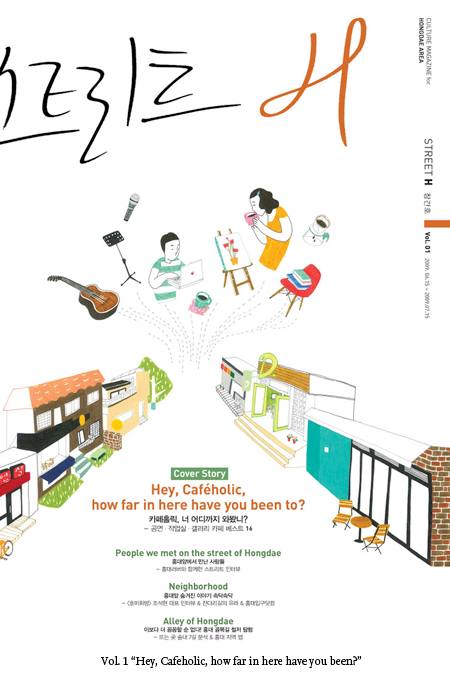
The History of Seoul's Hondgdae in 'Street H'

Street H is a local magazine made by the creative younger generation thriving in Hongdae and for those that congregate in Hongdae.


Hongdae is an abbreviation of Hongik University (Hongik Daehakgyo) in Korean, and generally refers to the area of Seogyo-dong, a hub for young artists and underground culture in Seoul.

The neighborhood overflows with unique cafes, restaurants, shops and clubs along with artists' studios, cultural spaces and festivals year-round. Packed with people on weekends the district can be thumping well past dawn the next day. Revelers may abound but the real Hongdae people and those involved with Street H know it’s not just about clubbing or decadence.


The magazine explores a variety of themes infused in the area. In fact, anything about Hongdae could be a topic for Street H _ small bookshops, a bike-riding map, real estate prices, cafes with terraces, humanities studies, the death of Club Day and the streets of Hongdae seen from the second floor.

Street H was established in June 2009 and last month released its 32nd volume featuring Hongdae people with particular jobs such as a tattooist, interdisciplinary artist and creature creator.

The free magazine is published by a man who lived in the area for around 30 years.


"There are many interesting things happening in this neighborhood and I thought I would do something interesting about the area,” said Jang Sung-hwan, publisher and Street H and CEO of Design Studio 203. As expected he earned his bachelor's degree in visual design and master's degree in industrial design at Hongik University.

Local magazines in New York City such as L Magazine and Village Voice inspired Jang to do something similar. "I have worked in the magazine and publishing industry for some 20 years and I decided to do what I can do best _ make a magazine about the Hongdae area."

Two-thousand copies of Street H are distributed across Hongdae area every month through selected cafes, book stores and tourist information centers. The magazine, including back numbers, is available through its website at www.street-h.com and electronic magazine platforms such as Moazine and MegaVista as well.


"The magazine is quite popular in the area and it is all gone within a week after distribution, sometimes faster," he said. “We might increase the circulation a bit as more people want to read Street H, but we won’t print 10,000 copies of it because it would be too much for a local paper focused on just the Hongdae area.”

Making Street H

Currently, Street H is written by guest reporters and a talented group of contributing writers. It is not sponsored or print advertisements. Though they are not paid, they write about every part of the neighborhood in an affectionate way. “The difference comes from the fact that we ‘stay’ here. Other reporters come here to write the story,” Jang said.

Each volume of Street H has a map of Hongdae area marked with cafes, clubs and other cultural spaces. Jang believes the map contains more than just location information.


"I think the map is about existence information which bears information about what is here now and what is gone," Jang said. "When the maps are accumulated and layered, it is history.”

Jang said the map has changed a lot since the beginning in 2009. “At first, our map only covered the Seogyo-dong area in front of Hongik University. Now it is expanded to include Sangsu-dong, Hapjeong-dong and Donggyo-dong,” he said. “When we had put the 24 maps together at the magazine’s 2nd anniversary exhibition, it showed the changes of the neighborhood at a glance.”

Street H is a magazine that cares about people. The stories "cover every inch of Hongdae _ the people who make everything here and those who come to participate in the culture," he said. "We are interested in what people are doing and why."


However, the monthly is not all about hip youngsters in the area. It also interviews older people who are longtime residents, art supply store managers and other mom-and-pop store owners.

“We try to balance the magazine by paying attention to social issues happening in the area such as Dooriban, a noodle restaurant that fought hard against a redevelopment project,” he said.


Archiving Hongdae

The cover of the January 2012 issue was an illustration depicting the scenery at a three-way intersection showing the yellow-sign of Record Forum and a house with a red roof.

"In 2012, we will depict the year of Hongdae through illustrations,” the publisher said. “I know it is impossible to document everything about the Hongdae area, but we do want to record as much as possible, especially meaningful places such as the Richemont Bakery.”

Richemont, a bakery that opened in front of Hongik University in 1984, closed on Jan. 31 due to the termination of the rental contract with the landlord. The place will reopen as a franchise coffee shop run by a conglomerate in February.

The closure of the cherished bakery did not go unnoticed by local merchants. “Though the physical place is gone, the bakery will remain in our memories. I think that is one of the reasons why we document the Hongdae area,” he said.

Street H is expanding communication with readers and local residents through Twitter (@_streeth) as well. “When we asked for recommendations for next month’s cover illustration, we received a lot of interesting feedback. One of them said he was born at a house now turned into a restaurant. The history of the area is made up of such developments,” Jang said.

Street H published "12 Fascinating Cafes," the first of its accordion book series featuring illustrations of 12 cafes in the Hongdae area by Hur Kyung-mi, in January. The 15 centimeter by 15 centimeter book expands to 1.8 meters when fully unfolded. The 12 cafes in the book include local fixtures B-hind, 405 Kitchen, Jenny's Cafe, D'avant, Cafe Sukara, Coffee Lab and Mobssie.

"We chose cafes that lasted for at least three years and are expected to stay longer," Jang said. "We aim to capture the nostalgia of the district in the book."

Jang plans to continue the accordion book series with various ways to remember the alley ways in Hongdae area. "I could collaborate with artists who take photos of life in the streets or make stamps of buildings," he said. "There is no souvenir of Hongdae which people can take home and remember this area booming with creativity. The book is a result of a designer's answer to this dilemma."

It is a part of Street H's bigger plan to create a cultural hub in the area.

"It's tentatively named Street H Spot. The place is going to be a magnet for tourists where they can have a cup of coffee or a bowl of warm vegetable soup, share information on the Hongdae area and get some souvenirs,” he said. “The accordion book is like a part of Hongdae you can take home and cherish.”

For more information about the magazine, visit www.street-h.com or call (02) 323-2569.

Source: The Korea Times

Thursday, February 2, 2012

Daeboreum

Daeboreum literally meaning "Great Full Moon", is a Korean holiday which celebrates the first full moon of the new year of the lunar Korean calendar. This holiday is accompanied by many traditions.

One familiar custom is to crack nuts with one's teeth. It is believed that this practice will help keep one's teeth healthy for the year.
In the countryside, people climb mountains, braving cold weather, trying to catch the first rise of the moon. It is said that the first person to see the moon rise will have good luck all year or a wish will be granted.
Historically, people played the traditional game named geuybulnori (쥐불놀이) the night before daeboreum. They burned the dry grass on ridges between rice fields while children whirled around cans full of holes, through which charcoal fire blazed. These cans fertilized the fields and get rid of harmful worms that destroyed the new crops.

For breakfast on Daeboreum, Ogokbap (오곡밥 / 五穀밥), a five-"grain" rice consisting of rice, millet, Indian millet, beans, and red beans is served (gok includes grains and beans). This is eaten with various dried herbs. One of the special foods of Daeboreum is Yaksik (약식 / 藥食). This treat is made of glutinous rice, chestnuts, pinenuts, honey, sauce, and sesame oil.
On this day, Koreans traditionally do not give any food to dogs since it is believed that dogs that eat on this day will contract gad flies and become ill during the coming summer.

South Korean Leading Brand Samsung races ahead in tech industry


Samsung Electronics aims to sell more premium smartphones and advanced TVs, as well as chips and flat-screens.

``Samsung Electronics has continued to generate outstanding results despite an unfavorable economic climate and is widening the gap with regional competitors,’’ said Fitch Ratings. The company had a record-breaking year in 2011.

The world’s biggest manufacturer of memory chips and liquid crystal displays (LCDs), said demand for semiconductors for mobile products and servers remained solid despite a weaker showing in personal computers, due to competition from the rising popularity of tablets.


``Samsung aims at 180 trillion won in revenue or slightly more throughout this year. We are optimistic in attaining our target of $200 billion in revenue earlier than planned,’’ CEO Choi Gee-sung said recently.


Despite this the company admitted that its growth last year was slower than expected because of economic uncertainties in developed markets, the massive earthquake in Japan and the aftermath of massive flooding in Thailand.

In 2011 Samsung saw 7 percent revenue growth with a 165 trillion won total compared to the previous year, said investor relations chief Robert Yi.

The company and its affiliates plan to invest a record 47.8 trillion won this year on new product research and upgrading plants.

Samsung has diversified into value-added chips capitalizing on mobile application processors (APs) for tablets, smartphones and corporate servers.

The world’s biggest memory chipmaker sells twice as many ``specialty DRAM chips,’’ where margins are higher, as commoditized chips used in PCs, said Shinhan Investment in a recent report to clients.


One ace in the hole is the soaring popularity of Samsung’s Galaxy-branded smartphones.

The top smartphone seller in 2011, is pretty confident to outpace the Finnish handset maker Nokia to become the world’s biggest mobile phone producer, said CEO Choi.

It aims to sell over 130 million smartphones by the end of this year of a total 360 million target, according to company executives.

Smartphone sales in 2011 more than quadrupled from the year before, said Boston-based Strategy Analytics, generating record operating profit and revenue for the telecommunications division. Profit jumped 79 percent to 2.64 trillion won in the fourth quarter of last year.

``By expanding the lineup of smartphones and feature-based devices, Samsung will outpace market growth,’’ said Lee Young-hee, a senior vice president for the mobile division.


The company’s smartphone business was the biggest contributor to the corporation’s bottom line last year. With improving signs for traditionally-strong businesses ― chips, LCDs and TVs ― smartphones is the strongest provider of profits.

``In smartphones, the whole competition boils down to Apple and Samsung now,’’ said Lee Jin-woo, a fund manager at Seoul-based KTB Asset Management.

Samsung has been expanding its patent litigation against Apple after the latter sued it in April last year in the United States by claiming that ``Samsung slavishly copied the designs Apple smartphones and iPads.’’

The legal tussle has now spilled over into 10 countries, according to officials. The court fight is entering a ``big turning-point’’ after the latest ruling in Germany sided with Apple.

``The patent fight will have a lesser impact on Samsung’s smartphone business because we will release more models in all markets,’’ said a spokesman.

Samsung is also preparing a comeback in its television business after last year’s dismal performances hit by the debt-crisis in the eurozone and declining prices.

The company aims to sell 50 million flat-screen TVs this year, according to executives. ``Samsung sold 43 million, last year and we are aiming to sell 15 percent more this year,’’ said Yoon Boo-keun, the chief of the consumer electronics division.

This year’s key phrase for the company’s TV business is ``beyond comparison,’’ said Yoon, expecting demand in emerging markets to ``significantly grow.’’

Samsung is adding more features to its Web-connected or ``Smart TVs,’’ the TVs that allow users to download apps, movies and surf the Internet. Samsung defines a smart TV as having built-in computer-style processors and a software platform that allows for custom-made applications.

``Last year, sales of smartphones and tablets negatively affected TV demand, but this year, those products will create synergies with smart TVs,’’ said Yoon, adding Samsung is prepared to fight Apple over ``Apple TVs,’’ which will be released sometime in the second half.

In personal computers, which Samsung has seen higher growth over the past few years, its chief Nam Seong-woo said the company will sell 19 million this year up from 14 million in 2011.

``That’s enough to lift the worldwide ranking to the 6th biggest manufacturer. We are on track. We will gain more profitability by selling more premium-level products,’’ said Nam.

In chips and flat-screens, Samsung confirmed its bullish stance to widen market gaps with its rivals.

Out of the total allocation for semiconductors this year ― 15 trillion won ― the world’s biggest memory chipmaker plans to invest 9 trillion won in the less-volatile and profitable non-memory chips.

These chips are used to control an entire computing system and are more profitable. Samsung supplies some of these chips to Apple.

In conventional memory chips, Yi said the company will raise the portion of DRAM chips using below 30-nanometer processing technology to 60 percent by the end of the year, while that for NAND flash chips using 20-nanometer will be over 90 percent.

In the fourth quarter, the semiconductor division had a 2.31 trillion won operating profit on 9.17 trillion won in revenue, on the back of the rising shipment of more profitable chips.

The spending amid technology migration and rising profit contrasts with Asian rivals including Japan’s only DRAM chipmaker Elpida Memory, which was unprofitable for four straight quarters to September and faces a deadline to repay debts.

``We’ve acknowledged that Elpida is moving to integrate business management with Micron Technology of the United States and Nanya from Taiwan as a strategy to compete with Samsung and even Hynix, however, we don’t worry too much,’’ said a senior executive.

In organic light-emitting diode (OLED) business, considered the next-generation display format that will eventually replace LCDs and plasma panels, Samsung plans to invest 5 trillion won out of 6.6 trillion won allocated to its entire display-panel business.

``Our LCD screen business was in the red last year. But we will do our best to see an early turnaround in the display-making business by expanding OLED production and cutting costs in LCDs by using advanced technology,’’ said Yi.

Source: The Korea Times