Ulleungdo is a South Korean island in the East Sea. Formerly known as Dagelet to the Europeans, Ulleungdo is about 120 km (75 mi) east of the Korean Peninsula. Volcanic in origin, the rocky steep-sided island is the top of a large stratovolcano which rises from the seafloor, reaching a maximum elevation of 984 metres (3,228 ft) at Seonginbong Peak.
The island consists primarily of trachyandesite rock. A major explosive eruption about 9,350 years ago reached a Volcanic Explosivity Index of 6 and deposited tephra as far as central Honshū over 800 km (500 mi) away, while producing pyroclastic flows on the island and decapitating its top to form a caldera.
The island of Ulleungdo has an area of 73.15 km2 (28.24 sq mi) with about 10,000 inhabitants according to our Guide. It makes up the main part of Ulleung County, North Gyeongsang Province, South Korea. The main city of Ulleungdo is the port of Dodong, which serves as the main ferry port between Ulleungdo and the Korean mainland. Ulleungdo is a popular tourist site.
The other main economic activity is fishery, including the harvest of cuttlefish, which can be seen drying in the sun in many places on Ulleungdo. Most Koreans know the island for its cuttlefish.
Archaeological evidence indicates that the island has been inhabited since the 1st millennium BC. The first confirmed historical reference to Ulleungdo is in the Samguk Sagi for the year 512. In that year, the Silla general Kim Isabu conquered the island, which had previously been the autonomous nation of Usan-guk.
Usan-guk did not remain under the Silla yoke, however, and the island did not become a permanent political part of Korea until 930, when it was annexed by Goryeo. Remote as it is from the Korean mainland, Ulleungdo was a recurrent security headache for the Goryeo and Joseon dynasties. It was devastated by Jurchen pirate raids in the 11th century, and by Wokou pirate raids in the 14th century. A clash with Japan over fishing rights in the 1690s was precipitated by the Korean fisherman An Yong-bok. In response to these difficulties, Joseon adopted an "empty-island" policy which however proved impossible to enforce. The empty-island policy was officially rescinded in 1881, after which the government sought to encourage additional settlement of Ulleungdo.
Favorite activities for tourists are hiking, fishing,digging out the roots of thodok and eating hoe (a Korean raw fish dish). Sightseeing boats make regular three-hour circuits about Ulleungdo, departing from the harbor at Dodong and passing by all the points of interest along the coast, including many interesting rock formations and the small neighboring island of Jukdo.
I learned from the guide as well as from the driver who take us every possible part of this mistery Island that Ulleungdo have its own unique qualiteis that make different from the others i.e the cleaniest environment and preety womens , kind hearted people , the scary wind which can washed away the houses , the thodok one of the precious herb which is abundently available in Ulleungdo, The dried O-zingo or the squid and of course one and only Ulleungdo people life line the Bokpo waterfall an only fresh water where the 10,000 people are depending on.
Frens, seriously I really appreciate this place because after the Dokdo issue Ulleungdo became famous as well the transportation is so good even if its away from the crowded mainland Korea.

Let's explore the rich culture, beautiful scenic view, delicious and colorful gourmet,high infrastructure, high life-style, tourist spot, people and educational activities of Korea from my window called the "MYSTIC KOREA".
Friday, May 20, 2011


Sunday, May 15, 2011
Globally Successful Food
There are Something Special about Globally Successful Food
Do you think it is possible to attract everyone in the world with a same food? It is not simply a question of Korean food. Even if it has an excellent taste, it is almost impossible to satisfy 7 billion people around the world. Nevertheless, there are many foreign dishes which became the beloved food among many countries.
For example, pizza of Italy, Sushi of Japan, Curry of India, and Pho of Vietnam are beloved by many people around the world with no validity term. Even though people don’t know where those countries are located, but they know exactly where the top gourmet restaurants are. Well then, let’s take a look inside the secrets of the globally successful food!!
Reborn as Korean foods

In Thailand, Jajangmyeon’ was selected as the most ‘want-to-try’ food of Korea among young people. It is a surprising result when considering that many Thailand the Korean drama and music are sweeping over the country. But in fact, Koreans themselves don’t regard Jajangmyeon as Korean food.
The name of Jajangmyeon was derived from the word ‘Zhajiangmian(炸酱面)’ in China. In the past, many Chinese ordinary people used to add ‘Chunjiang(椿酱)’, Chinese fermented soybean paste in the noodle. Like many Chinese who settled in other countries, Chinese in Korea also had this noodle, but in a little different way, adding caramel, vegetables and meats. As time goes by, the way of cooking Zhajiangmian and its ingredients have been changed to fit the Korean’s tastes, which is now Jajangmyeon.
There are a number of foreign dishes beloved by Koreans, even if they haven’t been changed as much as Jajangmyeon. For example, there is a huge difference between the Korea-made pizza and Italy-made pizza which is baked over stove. Unlike the original pizza with one or two fresh ingredients on its thin and crispy bread, the Korea-made pizza has a lot of toppings and sauce on its soft and thick bread. Yes, it was changed to fit the Koreans’ tastes who love soft and chewy food.
To be accurate, as the Italian pizza became Americanized in the U.S., many things including dough, ingredients and even the method of cooking were changed a bit. After then, the Americanized pizza arrived in Korea and it once again had a change. Even though many Koreans love pizza itself, there are still a lot of pizza companies which are trying to develop their pizza to fit the Koreans who are accustomed to spicy food.


Pasta is a similar example. It came across to Korea not from Italy, but from the Italian restaurant in the U.S. and Japan. The Pasta was changed again in Korea, and got to have a new style and develop the new tastes.
Well, there is a significant difference between the pasta which is commonly sold in Korea and the original pasta, comparing the amount of sauce. The Italian pasta, which is a one of favorite dishes and courses among common people, originally has little sauce. However in Korea, people get used to have ‘one dish for a meal’, so the amount of sauce has increased like a noodle soup and satisfied their appetite.
Interesting fact here is that Kimchi or Gochujang(red pepper paste) added pasta is being exported overseas. People said that it is a reexportation of pasta. ‘Ramyeon’ is another example of the exported foreign dishes from Korea. First made in Japan, ramyeon which had arrived in Korea in late 1950s became one of the biggest trends ever. Since 2000, ramyeon industry in Korea has begun to rise rapidly, and exported ramyeon to Japan which is the home of ramyeon. Moreover, Korean ramyeon product was ranked the ‘globally recognized brand” by TokyoTV.
Successful Cases. We are More Delicious and Exclusive!
Thailand dishes

Most of the South East dishes that are well-known among Koreans are from Vietnam, such as rice noodle and rice wraps. But in terms of generalization, there must be the Thailand dishes. Regardless of the nation’s competitiveness and image, Thailand dishes are getting more popular and popular with the support of public sectors and the government. Those support started from 2004, when they launched the slogan, Thai-ness, in order to globalize the Thailand dishes. For this reason, people around the world not only order the menu but also remember the Thailand culture and its nation brand.
The key to success is that they just let people try their dishes by recommending as they do to their friends. Opening the restaurant in neighboring countries, they stick to their original tastes, but in remote countries like U.S. they tried to change their dishes to fit their tastes. For the reason, the Thailand dishes in close countries, such as Laos, Malaysia and Cambodia still have the piquant and spicy tastes even though the ingredients are little bit different. On the other hand, in Korea or western countries, they are working on to remove ‘Pak Chee’, Thailand’s representative spices or add more sweetness and salty taste. Through this relative PR strategy, the number of Thailand restaurants all over the world increased over 13,000, comparing the 4,000 restaurant in 2004.
Sushi, VIP menu in the world restaurant

< Sushi >
Japan has set out to attract over 1.2 billion from 600 million people to Japanese food by 2012. And in fact, the population enjoying the Japanese food is rapidly increasing. Especially the PR strategy which aims at spreading the image of sushi to Europe, U.S., Asia and Africa as a gourmet food of the upper ten was considered successful. In addition, they promote the export of Japanese food supplies with the scientific data that they can make best sushi with the food supplies from Japan, which became a role model for many countries.
In particular, they published the book ‘How to eat Sushi’ telling the history of Sushi and how to use the chopstick, and how to eat Sushi, which made Sushi closer to foreign people as a culture. Thanks to the concrete and systematic strategy, currently in U.S., there are 10,000 Japanese restaurants, which is almost a half of the total Japanese restaurant all over the world.
More Chinese restaurant than McDonald in Korea

Chinese restaurants have succeeded around the world with its own efforts to develop the menu, which differentiates them from the Japanese and Thailand restaurants that were supported by their governments. You will be surprised to know that the globalization of the Chinese restaurant already started 150 years ago, which is far earlier than their government’s PR strategy on food. In 1850s, for the Gold Rush in U.S., more than 25,000 Chinese moved over to the U.S. and the first Chinese restaurant Chow Chows’ opened. Naturally, Americans were fascinated by the cheap and plentiful Chinese food.
The Chinese restaurants which are well on the way to establishing itself in the U.S., soon expanded to the big cities and the suburb areas and became Americanized, focusing on increasing the number of enterprising franchises. Now, it opened over 40,000 Chinese restaurants, which is more than the number including McDonald, Burger King, and Wendy.
Korean Dishes in the World, Where do we stand?

Taking a look at many successful cases of foreign dishes, you might wonder then, “What is the current position of Korean dishes”? So, we did analysis about the foreigners’ preferences on Korean dishes, such as Kimchi, Bibimbap, and Bulgogi which are considered known overseas. The statistics results were based on the Accenture Survey and Analysis implemented on June 2009.
First of all, 21% out of all foreigners who answered the survey came up with ‘Korean dishes’ from the word ‘Korea’. Most of them considered Kimchi is the representative food of Korea, and they were quite positive on its tastes, answering that it is rather spicy but very delicious. In particular, the Americans who participated in the survey answered that Korean dishes are mostly unique, inexpensive, and quite extensive. They also regarded that Korean dishes would be good to health and diet.
Meanwhile, ‘Bulgogi’ was selected the ‘most satisfactory dish’, recording 4.4 out of 5. Dakgalbi, which is spicy even to Koreans, got 4.3 unexpectedly. For the next, Bibimbap and Ddokgalbi recorded 4.2. Well, there are also other dishes that scored pretty low we need to check. Dongchimi noodles and Naengmyeon got around 3 points. It is expected that foreigners don’t like cold noodles.
Like many other countries which tried hard for globalization, we also need to be aware of the current status of Korean food, keep our own traditional value and develop the localized recipe by country. Then one day in the near future, we can enjoy Korean food with all of our friends in the world.
Do you think it is possible to attract everyone in the world with a same food? It is not simply a question of Korean food. Even if it has an excellent taste, it is almost impossible to satisfy 7 billion people around the world. Nevertheless, there are many foreign dishes which became the beloved food among many countries.
For example, pizza of Italy, Sushi of Japan, Curry of India, and Pho of Vietnam are beloved by many people around the world with no validity term. Even though people don’t know where those countries are located, but they know exactly where the top gourmet restaurants are. Well then, let’s take a look inside the secrets of the globally successful food!!
Reborn as Korean foods

In Thailand, Jajangmyeon’ was selected as the most ‘want-to-try’ food of Korea among young people. It is a surprising result when considering that many Thailand the Korean drama and music are sweeping over the country. But in fact, Koreans themselves don’t regard Jajangmyeon as Korean food.
The name of Jajangmyeon was derived from the word ‘Zhajiangmian(炸酱面)’ in China. In the past, many Chinese ordinary people used to add ‘Chunjiang(椿酱)’, Chinese fermented soybean paste in the noodle. Like many Chinese who settled in other countries, Chinese in Korea also had this noodle, but in a little different way, adding caramel, vegetables and meats. As time goes by, the way of cooking Zhajiangmian and its ingredients have been changed to fit the Korean’s tastes, which is now Jajangmyeon.
There are a number of foreign dishes beloved by Koreans, even if they haven’t been changed as much as Jajangmyeon. For example, there is a huge difference between the Korea-made pizza and Italy-made pizza which is baked over stove. Unlike the original pizza with one or two fresh ingredients on its thin and crispy bread, the Korea-made pizza has a lot of toppings and sauce on its soft and thick bread. Yes, it was changed to fit the Koreans’ tastes who love soft and chewy food.
To be accurate, as the Italian pizza became Americanized in the U.S., many things including dough, ingredients and even the method of cooking were changed a bit. After then, the Americanized pizza arrived in Korea and it once again had a change. Even though many Koreans love pizza itself, there are still a lot of pizza companies which are trying to develop their pizza to fit the Koreans who are accustomed to spicy food.


Pasta is a similar example. It came across to Korea not from Italy, but from the Italian restaurant in the U.S. and Japan. The Pasta was changed again in Korea, and got to have a new style and develop the new tastes.
Well, there is a significant difference between the pasta which is commonly sold in Korea and the original pasta, comparing the amount of sauce. The Italian pasta, which is a one of favorite dishes and courses among common people, originally has little sauce. However in Korea, people get used to have ‘one dish for a meal’, so the amount of sauce has increased like a noodle soup and satisfied their appetite.
Interesting fact here is that Kimchi or Gochujang(red pepper paste) added pasta is being exported overseas. People said that it is a reexportation of pasta. ‘Ramyeon’ is another example of the exported foreign dishes from Korea. First made in Japan, ramyeon which had arrived in Korea in late 1950s became one of the biggest trends ever. Since 2000, ramyeon industry in Korea has begun to rise rapidly, and exported ramyeon to Japan which is the home of ramyeon. Moreover, Korean ramyeon product was ranked the ‘globally recognized brand” by TokyoTV.
Successful Cases. We are More Delicious and Exclusive!
Thailand dishes

Most of the South East dishes that are well-known among Koreans are from Vietnam, such as rice noodle and rice wraps. But in terms of generalization, there must be the Thailand dishes. Regardless of the nation’s competitiveness and image, Thailand dishes are getting more popular and popular with the support of public sectors and the government. Those support started from 2004, when they launched the slogan, Thai-ness, in order to globalize the Thailand dishes. For this reason, people around the world not only order the menu but also remember the Thailand culture and its nation brand.
The key to success is that they just let people try their dishes by recommending as they do to their friends. Opening the restaurant in neighboring countries, they stick to their original tastes, but in remote countries like U.S. they tried to change their dishes to fit their tastes. For the reason, the Thailand dishes in close countries, such as Laos, Malaysia and Cambodia still have the piquant and spicy tastes even though the ingredients are little bit different. On the other hand, in Korea or western countries, they are working on to remove ‘Pak Chee’, Thailand’s representative spices or add more sweetness and salty taste. Through this relative PR strategy, the number of Thailand restaurants all over the world increased over 13,000, comparing the 4,000 restaurant in 2004.
Sushi, VIP menu in the world restaurant

< Sushi >
Japan has set out to attract over 1.2 billion from 600 million people to Japanese food by 2012. And in fact, the population enjoying the Japanese food is rapidly increasing. Especially the PR strategy which aims at spreading the image of sushi to Europe, U.S., Asia and Africa as a gourmet food of the upper ten was considered successful. In addition, they promote the export of Japanese food supplies with the scientific data that they can make best sushi with the food supplies from Japan, which became a role model for many countries.
In particular, they published the book ‘How to eat Sushi’ telling the history of Sushi and how to use the chopstick, and how to eat Sushi, which made Sushi closer to foreign people as a culture. Thanks to the concrete and systematic strategy, currently in U.S., there are 10,000 Japanese restaurants, which is almost a half of the total Japanese restaurant all over the world.
More Chinese restaurant than McDonald in Korea

Chinese restaurants have succeeded around the world with its own efforts to develop the menu, which differentiates them from the Japanese and Thailand restaurants that were supported by their governments. You will be surprised to know that the globalization of the Chinese restaurant already started 150 years ago, which is far earlier than their government’s PR strategy on food. In 1850s, for the Gold Rush in U.S., more than 25,000 Chinese moved over to the U.S. and the first Chinese restaurant Chow Chows’ opened. Naturally, Americans were fascinated by the cheap and plentiful Chinese food.
The Chinese restaurants which are well on the way to establishing itself in the U.S., soon expanded to the big cities and the suburb areas and became Americanized, focusing on increasing the number of enterprising franchises. Now, it opened over 40,000 Chinese restaurants, which is more than the number including McDonald, Burger King, and Wendy.
Korean Dishes in the World, Where do we stand?

Taking a look at many successful cases of foreign dishes, you might wonder then, “What is the current position of Korean dishes”? So, we did analysis about the foreigners’ preferences on Korean dishes, such as Kimchi, Bibimbap, and Bulgogi which are considered known overseas. The statistics results were based on the Accenture Survey and Analysis implemented on June 2009.
First of all, 21% out of all foreigners who answered the survey came up with ‘Korean dishes’ from the word ‘Korea’. Most of them considered Kimchi is the representative food of Korea, and they were quite positive on its tastes, answering that it is rather spicy but very delicious. In particular, the Americans who participated in the survey answered that Korean dishes are mostly unique, inexpensive, and quite extensive. They also regarded that Korean dishes would be good to health and diet.
Meanwhile, ‘Bulgogi’ was selected the ‘most satisfactory dish’, recording 4.4 out of 5. Dakgalbi, which is spicy even to Koreans, got 4.3 unexpectedly. For the next, Bibimbap and Ddokgalbi recorded 4.2. Well, there are also other dishes that scored pretty low we need to check. Dongchimi noodles and Naengmyeon got around 3 points. It is expected that foreigners don’t like cold noodles.
Like many other countries which tried hard for globalization, we also need to be aware of the current status of Korean food, keep our own traditional value and develop the localized recipe by country. Then one day in the near future, we can enjoy Korean food with all of our friends in the world.
Friday, May 6, 2011
The World Natural Treasure, the Mother Nature of Jeju Island ‘Oreum’
Jeju Island gifted with nature sceneries and 1,700 species of plants, is a marvelous place where you can experience unique geographical features nowhere else can offer. In the center there is the proudly splendid Halla Mountain and neighboring oreums – low mountains of Jeju - reveals the original beauty of the geography of the volcanic island.
Oreum is a Jeju dialect for a low mountain. There are a good number of oreums as there is even a saying that people of Jeju are born from and returns to oreum after death. Near 380 of oreums are distributed in the island, which way exceeds 250 i.e. the number of those in Mt Etna of Italy.
Oreum consisted of grassland, natural and artificial forest, and wetland, is distributed intensively in the bottom area of Mt Halla and hilly and mountainous areas. As the altitude of the areas differs the ecological variety is well preserved with high potential value.
To be recognized as oreum the mountain should be qualified to have all required component i.e. a crater, shape, and contents; a crater formed by volcanic eruption; shapes of volcanic ashes and scoriae, and sedimentary layer; and pyroclastic materials. Also it is called as ‘ak’ or ‘bong’; Seongsan Ilchulbong, Dusanbong, Songaksan are some examples.
Oreums with different shapes and heights placed along by the ridges of Mt Halla and the coastline of the island invites you to the breathtaking beauty of the Mother Nature Jeju.
The ace view, Nokkome oreum

< Nokkomeoreum, where 112 families and 469 species of plants reside> (image: Official Blog of Jeju, New 7 Wonders)
Nokkomeoreum 833.8m above the sea level, covering an area of 923,692㎡ with the height of 234m, girth of 4,390m, and a smaller Nokkomeoreum is also known as ‘brother oreum’ as a pair sitting next by each other. The two mountains stand in high spirits and its exploded crater area is enough to thrill your eyes. Some people are surprised as they think ‘Nokkome’ is Japanese but in fact it derives from a Korean expression ‘Nopgome’ meaning ‘it is high.’
In the Nokkomeoreum area there are animal species that are protected species (class 2) by the Ministry of Environment including roe, weasel of Jeju, badger and so on. Endangered animals including birds such as goshawk, brown-eared bulbul, kestrel, bush warbler and Red-tongue pit-viper, takydromus wolteri and others are residing as well. Also there are 112 families and 469 species of plants e.g. nutmeg tree, hornbeam, and Galeola septentrionalis Reichb. For sure Nokkomeoreum area is some repository of various species of animals and plants.
If you follow the ridges of the hills a scenic panorama with different faces of Mt Halla and oreums is revealed. At the northern mountain top the view of Jeju city and the sea can be seen at a look. An average of 4~500 people on weekdays and 2~3,000 people on weekends visit the area to see this extraordinary scene. Why not check out Nokkomeoreum yourself and experience the grandeur gift of the nature?
The Queen of Oreum, Darangswioreum

(image: Kyunghyang Shinmun)
Darangswi oreum representing Gujwa town is 382.4m above the sea level, covering an area of 800,463㎡ with the height of 227m, and girth of 3,391m. It was named as so because of the crater of the mountain looks round as a moon (Darang sounds similar to ‘dal’ that is moon in Korean). Darangswi oreum is the pride of the villagers as it presents a uniquely beautiful scene for viewing the moon when the full moon rises behind the round crater of the oreum.
While most oreums have asymmetric slops, Darangswi oreum is a vertically balanced oval shape; this outstanding beauty of proportion surely gives a good reason for its title i.e. the ‘Queen of oreum.’
On top of the mountain, there is a funnel shape of huge circular crater. The circumference of the outside of crater is reaching 1,500m, and its depth is 115m just as deep as baekrokdam of Mt. Halla. The area is dense with weeds and cedars on its foot. The area is a huge grassland and if the weather is good, you can see the Seongsan Sunrise Hill, Udo and a wind power plant complex.
There is a saying that you didn’t see the real Jeju until climbing up Oreum., after the wood stairs to Darangswi oreum were built in 2005, the number of visitors increased. Why don’t you experience the ‘real’ Jeju at Darangswi oreum which is famous for paragliding and the annual Wallang hill Sunrise festivals?
Geomun Oreum listed on UNESCO’s World Cultural and Natural Heritage

(Image : Korea Tourism Organization)
Geomun Oreum, which has the most beautiful scenery among all Oreums in Jeju, is 456.6 meters above sea level, 112 meters high, 4,553 meters in circumference, and 809,860㎡ in extent, which of name, Goemun, was originated from a bunch of trees in that Oreum makes black color. (i.e. Goemun means black in Korean.) Only 300 visitors a day are allowed to go in, and the advanced reservation two days before is a must. It has the longest lava canyon throughout Jeju and the treasure of nature, ‘Gotjawal’, which has a high value in terms of geology as well as ecology.
The crater seen from the top of Goemun oreum spewed out lava to the ocean and created over 20 lava caves around, such as Bengdui cave, Manjang cave, Kimnyeongsa cave, etc. As designated as a World Cultural and Natural Heritage by UNESCO, oreum has the representative lava caves of Jeju. Among these caves, only Manjang cave is open to public. The course is flat and the passage is also wide that even the old and weak can look around without a big difficulty.
Al oreum is a paeasitic volcano that rose on the center of the crater of Geomun oreum. You can see 9 hills forming the Geomun oreum from the observatory which is 1km apart from the tour starting spot. In addition, the crater of Geomun oreum is 4 times larger than that of Mt Hall. You will be overwhelmed at the marvelous scenery of nature.
Before visiting Geomun oreum, the commentator for Natural Heritage gives several notices. You should wear the hiking boots, but not with the hiking stick. You can only bring a bottle of water.
Oreum is a Jeju dialect for a low mountain. There are a good number of oreums as there is even a saying that people of Jeju are born from and returns to oreum after death. Near 380 of oreums are distributed in the island, which way exceeds 250 i.e. the number of those in Mt Etna of Italy.
Oreum consisted of grassland, natural and artificial forest, and wetland, is distributed intensively in the bottom area of Mt Halla and hilly and mountainous areas. As the altitude of the areas differs the ecological variety is well preserved with high potential value.
To be recognized as oreum the mountain should be qualified to have all required component i.e. a crater, shape, and contents; a crater formed by volcanic eruption; shapes of volcanic ashes and scoriae, and sedimentary layer; and pyroclastic materials. Also it is called as ‘ak’ or ‘bong’; Seongsan Ilchulbong, Dusanbong, Songaksan are some examples.
Oreums with different shapes and heights placed along by the ridges of Mt Halla and the coastline of the island invites you to the breathtaking beauty of the Mother Nature Jeju.
The ace view, Nokkome oreum

< Nokkomeoreum, where 112 families and 469 species of plants reside> (image: Official Blog of Jeju, New 7 Wonders)
Nokkomeoreum 833.8m above the sea level, covering an area of 923,692㎡ with the height of 234m, girth of 4,390m, and a smaller Nokkomeoreum is also known as ‘brother oreum’ as a pair sitting next by each other. The two mountains stand in high spirits and its exploded crater area is enough to thrill your eyes. Some people are surprised as they think ‘Nokkome’ is Japanese but in fact it derives from a Korean expression ‘Nopgome’ meaning ‘it is high.’
In the Nokkomeoreum area there are animal species that are protected species (class 2) by the Ministry of Environment including roe, weasel of Jeju, badger and so on. Endangered animals including birds such as goshawk, brown-eared bulbul, kestrel, bush warbler and Red-tongue pit-viper, takydromus wolteri and others are residing as well. Also there are 112 families and 469 species of plants e.g. nutmeg tree, hornbeam, and Galeola septentrionalis Reichb. For sure Nokkomeoreum area is some repository of various species of animals and plants.
If you follow the ridges of the hills a scenic panorama with different faces of Mt Halla and oreums is revealed. At the northern mountain top the view of Jeju city and the sea can be seen at a look. An average of 4~500 people on weekdays and 2~3,000 people on weekends visit the area to see this extraordinary scene. Why not check out Nokkomeoreum yourself and experience the grandeur gift of the nature?
The Queen of Oreum, Darangswioreum

Darangswi oreum representing Gujwa town is 382.4m above the sea level, covering an area of 800,463㎡ with the height of 227m, and girth of 3,391m. It was named as so because of the crater of the mountain looks round as a moon (Darang sounds similar to ‘dal’ that is moon in Korean). Darangswi oreum is the pride of the villagers as it presents a uniquely beautiful scene for viewing the moon when the full moon rises behind the round crater of the oreum.
While most oreums have asymmetric slops, Darangswi oreum is a vertically balanced oval shape; this outstanding beauty of proportion surely gives a good reason for its title i.e. the ‘Queen of oreum.’
On top of the mountain, there is a funnel shape of huge circular crater. The circumference of the outside of crater is reaching 1,500m, and its depth is 115m just as deep as baekrokdam of Mt. Halla. The area is dense with weeds and cedars on its foot. The area is a huge grassland and if the weather is good, you can see the Seongsan Sunrise Hill, Udo and a wind power plant complex.
There is a saying that you didn’t see the real Jeju until climbing up Oreum., after the wood stairs to Darangswi oreum were built in 2005, the number of visitors increased. Why don’t you experience the ‘real’ Jeju at Darangswi oreum which is famous for paragliding and the annual Wallang hill Sunrise festivals?
Geomun Oreum listed on UNESCO’s World Cultural and Natural Heritage

Geomun Oreum, which has the most beautiful scenery among all Oreums in Jeju, is 456.6 meters above sea level, 112 meters high, 4,553 meters in circumference, and 809,860㎡ in extent, which of name, Goemun, was originated from a bunch of trees in that Oreum makes black color. (i.e. Goemun means black in Korean.) Only 300 visitors a day are allowed to go in, and the advanced reservation two days before is a must. It has the longest lava canyon throughout Jeju and the treasure of nature, ‘Gotjawal’, which has a high value in terms of geology as well as ecology.
The crater seen from the top of Goemun oreum spewed out lava to the ocean and created over 20 lava caves around, such as Bengdui cave, Manjang cave, Kimnyeongsa cave, etc. As designated as a World Cultural and Natural Heritage by UNESCO, oreum has the representative lava caves of Jeju. Among these caves, only Manjang cave is open to public. The course is flat and the passage is also wide that even the old and weak can look around without a big difficulty.
Al oreum is a paeasitic volcano that rose on the center of the crater of Geomun oreum. You can see 9 hills forming the Geomun oreum from the observatory which is 1km apart from the tour starting spot. In addition, the crater of Geomun oreum is 4 times larger than that of Mt Hall. You will be overwhelmed at the marvelous scenery of nature.
Before visiting Geomun oreum, the commentator for Natural Heritage gives several notices. You should wear the hiking boots, but not with the hiking stick. You can only bring a bottle of water.
Wednesday, April 27, 2011
Made in Korea : a special report from the food fest held in Imphal/ India
Hi everyone, we all know that Korea is getting bigger and bigger day by day through its smart power called "Hallyu". We all know that Hallyu is all about South Korean cultural items including drama, movies, food, K-pop/music , life style, fashion , cosmetics etc.

Here I would like to share my experience from my country here in India. India is a big and land of multi-dimensional culture shared with different ethnics, caste, culture as well as religions reside under one roof. On top of this India is the largest movies producing country. Bollywood the film city of India is compare with the Hollywood of west. Unlimited production of movies creates Indian cinema among the Inidan masses a big place. That's the reason why it is a bit difficult to break-through and surpass by the Korean movies and culture although , electonic products from the brand names like Samsung, LG'S, Daewoo,Hundai , Lotte etc become household names in every corner here in India.
Korean companies are flourshing in most of the big cities in India due to Korean Companies the demand rate of learning Korean language become populated. Even though, the popularity of Korean soft products like movies and dramas are slow in pace.
On the contrary of the above given information, here I would again like to share you about the popularity of Korean movies, drama, K-pop and fashion in the other corner in India.
North-East part of India has been always different from the other part of the country in every ways for example food habit, ways of living, life style, physical appearence. In these particular area people are highly appreciated Korean culture as weall as Korean dramas and movies , starting from an old age to the younger generations.
When we asked why they are so much into the Korean items and the movies, they said ther feel very inter-connected with their appearence and the cool picturisation. Most of the youngsters like all the k-pop singer due to Arirang channel and KBS channel.

At this moment,for the first time some of the foreign nations
are participating food festival held in Imphal, Manipur which is going on till 1 may. Korea, China , THailand and Tibet are the four countries participating among the local food stalls.

As I already mentioned earlier, starting from small children to the old people are crazy over Korean items are hogging into the Korean stall only. Since this is the first time the Korean stall sell few items especially the famus Kimchi, Kim, Kim-pap, and syngupsal.
Youngster keep visiting the stall just the see the glimpse and meet the stall owner and say some few greeting like "Annyong-haseyo" and "Khamsha-Hapnida" as they have learned from watching the Korean movies and dramas...

A charming lady of Thailand stall
This is an intersting experience which I am experiencing here in my home-town, I am so excited to see how much people of North-East India specially the Manipuris love the Korean items and the Korean people. They are looking forward to see and experience like this.... as the Manipur University will be introducing Korean language subject in the University.

The two awesome owner of the Korean stall
I hope if both countries government takes initiative to open Korean world here in this place it will be a great beneficial for both the society as well as both the countries.

A Manipuri family enjoying Korean Kimchi and other items from the foreign stalls

Here I would like to share my experience from my country here in India. India is a big and land of multi-dimensional culture shared with different ethnics, caste, culture as well as religions reside under one roof. On top of this India is the largest movies producing country. Bollywood the film city of India is compare with the Hollywood of west. Unlimited production of movies creates Indian cinema among the Inidan masses a big place. That's the reason why it is a bit difficult to break-through and surpass by the Korean movies and culture although , electonic products from the brand names like Samsung, LG'S, Daewoo,Hundai , Lotte etc become household names in every corner here in India.
Korean companies are flourshing in most of the big cities in India due to Korean Companies the demand rate of learning Korean language become populated. Even though, the popularity of Korean soft products like movies and dramas are slow in pace.
On the contrary of the above given information, here I would again like to share you about the popularity of Korean movies, drama, K-pop and fashion in the other corner in India.
North-East part of India has been always different from the other part of the country in every ways for example food habit, ways of living, life style, physical appearence. In these particular area people are highly appreciated Korean culture as weall as Korean dramas and movies , starting from an old age to the younger generations.
When we asked why they are so much into the Korean items and the movies, they said ther feel very inter-connected with their appearence and the cool picturisation. Most of the youngsters like all the k-pop singer due to Arirang channel and KBS channel.

At this moment,for the first time some of the foreign nations

are participating food festival held in Imphal, Manipur which is going on till 1 may. Korea, China , THailand and Tibet are the four countries participating among the local food stalls.

As I already mentioned earlier, starting from small children to the old people are crazy over Korean items are hogging into the Korean stall only. Since this is the first time the Korean stall sell few items especially the famus Kimchi, Kim, Kim-pap, and syngupsal.

Youngster keep visiting the stall just the see the glimpse and meet the stall owner and say some few greeting like "Annyong-haseyo" and "Khamsha-Hapnida" as they have learned from watching the Korean movies and dramas...


A charming lady of Thailand stall
This is an intersting experience which I am experiencing here in my home-town, I am so excited to see how much people of North-East India specially the Manipuris love the Korean items and the Korean people. They are looking forward to see and experience like this.... as the Manipur University will be introducing Korean language subject in the University.

The two awesome owner of the Korean stall
I hope if both countries government takes initiative to open Korean world here in this place it will be a great beneficial for both the society as well as both the countries.

A Manipuri family enjoying Korean Kimchi and other items from the foreign stalls
Monday, April 18, 2011
Assimilation between Korean Shamanism and Sanamahism of Manipur
This is an interesting topic which deals about the Korean cultural activities as well as the old traditional rites and rituals.Another important thing is the role of women and their contribution towards the social activities.
One more thing I would like to mention here the comparison between the Meitei or Sanamahi culture and the Korean Shamanism.

source: from internet photo gallery.
The Korean shamanism are encompassing varieties of indigenous beliefs and practices which have been influenced by other religion. In contemporary Korea, shamanism is known as muism and a shaman is known as a mudang (무당, 巫堂). The role of the mudang, usually a woman, is to act as intercessors between a god or gods and human beings.Whereas, Sanamahism is the worship of Sanamahi, the Creator of the Meiteis. Sanamahism is one of the oldest sects of South Asia. It originated in Manipur, India and is mainly practiced by the Meiteis, Kabui, Zeliangrong and other communities who inhabit Manipur, Assam, Tripura, Myanmar and Bangladesh.

Lai Haraoba of Sanamahism : Lai Haraoba means "merry making of the Gods". It is a festival of the recollection of the creation stories and myth played by all deities with the first origin of this universe and evolution of the plants and animals through the will of Atiya Shidaba or the creator. And in this festival the Maibi or the Sahman roles are taken by the women mostly.
The rituals within the festival are the same except in some items or hymns, such as ikouba, ikourol, and yakairol at the beginning and mikon thagonba, ngaprum tanba at the end of the festival. In the performances, the evolution story with the amorous love-affairs of Nongpok Ninghthou and Panthoibi is depicted and played equally in all kinds of lai haraoba.

In the Korean case lso the interesting thing is the role of women, they are enlisted by those who want the help of the spirit world. Shamans hold gut, or services, in order to gain good fortune for clients, cure illnesses by exorcising lost spirits that cling to people, or propitiate local or village gods. Such services are also held to guide the spirit of a deceased person to heaven.
Even though belief in Korean shamanism is not as widespread as it once was in olden days,but still the practices are keep alive. In the past, shamanistic rites have included in agricultural activities, such as prayers for abundant harvesting. With a shift away from agriculture in modern Korea this has largely been exhtingushing now a days.
Korean shamanism have its own distinct feature by seeking to solve human problems through a meeting of humanity and the spirits. This can be seen clearly in the various types of gut (굿) that are still widely observed.
Often a woman will become a shaman very reluctantly--after experiencing a severe physical or mental illness that indicates possession by a spirit. Such possession allegedly can be cured only through performance of a gut. Once a shaman is established in her profession, she usually can make a good life.
Jeju Island is a center of Korean Shamanism .
The Origin of Korean Shamanism: Belief in a world inhabited by spirits is probably the oldest form of Korean religious life, dating back to prehistoric times.
Shamanism has its roots in ancient, land-based cultures, dating at least as far back as 40,000 years. The shaman was known as “magician, medicine man, psychopomp, mystic and poet” (Eliade, 1974). What set him apart from other healers or priests was his ability to move at will into trance states. During a trance, the shaman’s soul left his body and travelled to other realms, where helping spirits guided him in his work. The shaman provided healing on many levels; physical, psychological and spiritual. The work of the shaman was based on the holistic model, which took into consideration, not only the whole person, but that person’s interaction with his world, both inner and outer. The soul was considered the place of life breath, where essence resided, and any physical illness was inextricably linked with sickness of the soul. Illness of the mind had to do with soul loss, intrusion, possession.
There is a rather unorganized pantheon of many gods, spirits, and ghosts, ranging from the "god generals" who rule the different quarters of heaven to mountain spirits (sansin). This pantheon also includes gods who inhabit trees, sacred caves, and piles of stones, as well as earth spirits, the tutelary gods of households and villages, mischievous goblins, and the ghosts of persons who in many cases met violent or tragic ends. These spirits are said to have the power to influence or to change the fortunes of living men and children.
The rites themselves underwent a number of changes through the Silla and Goryeo periods. Even during the Joseon Dynasty which was heavily Confucian, shamanistic rites persisted.
Scholastic Opinion: Many scholars regard Korean shamanism as less a religion than a "medicine" in which the spirits are manipulated in order to achieve human ends.[citation needed] There is no notion of salvation or moral and spiritual perfection, at least for the ordinary believers in spirits. The shaman is a professional who is consulted by clients whenever the need is felt.

Animistic beliefs are strongly associated with the culture of fishing villages and are primarily a phenomenon found in rural communities. Shamans also treat the ills of city people, however, especially recent migrants from the countryside who find adjustment to an impersonal urban life stressful.
One more thing I would like to mention here the comparison between the Meitei or Sanamahi culture and the Korean Shamanism.

source: from internet photo gallery.
The Korean shamanism are encompassing varieties of indigenous beliefs and practices which have been influenced by other religion. In contemporary Korea, shamanism is known as muism and a shaman is known as a mudang (무당, 巫堂). The role of the mudang, usually a woman, is to act as intercessors between a god or gods and human beings.Whereas, Sanamahism is the worship of Sanamahi, the Creator of the Meiteis. Sanamahism is one of the oldest sects of South Asia. It originated in Manipur, India and is mainly practiced by the Meiteis, Kabui, Zeliangrong and other communities who inhabit Manipur, Assam, Tripura, Myanmar and Bangladesh.

Lai Haraoba of Sanamahism : Lai Haraoba means "merry making of the Gods". It is a festival of the recollection of the creation stories and myth played by all deities with the first origin of this universe and evolution of the plants and animals through the will of Atiya Shidaba or the creator. And in this festival the Maibi or the Sahman roles are taken by the women mostly.

The rituals within the festival are the same except in some items or hymns, such as ikouba, ikourol, and yakairol at the beginning and mikon thagonba, ngaprum tanba at the end of the festival. In the performances, the evolution story with the amorous love-affairs of Nongpok Ninghthou and Panthoibi is depicted and played equally in all kinds of lai haraoba.

In the Korean case lso the interesting thing is the role of women, they are enlisted by those who want the help of the spirit world. Shamans hold gut, or services, in order to gain good fortune for clients, cure illnesses by exorcising lost spirits that cling to people, or propitiate local or village gods. Such services are also held to guide the spirit of a deceased person to heaven.
Even though belief in Korean shamanism is not as widespread as it once was in olden days,but still the practices are keep alive. In the past, shamanistic rites have included in agricultural activities, such as prayers for abundant harvesting. With a shift away from agriculture in modern Korea this has largely been exhtingushing now a days.
Korean shamanism have its own distinct feature by seeking to solve human problems through a meeting of humanity and the spirits. This can be seen clearly in the various types of gut (굿) that are still widely observed.
Often a woman will become a shaman very reluctantly--after experiencing a severe physical or mental illness that indicates possession by a spirit. Such possession allegedly can be cured only through performance of a gut. Once a shaman is established in her profession, she usually can make a good life.
Jeju Island is a center of Korean Shamanism .
The Origin of Korean Shamanism: Belief in a world inhabited by spirits is probably the oldest form of Korean religious life, dating back to prehistoric times.
Shamanism has its roots in ancient, land-based cultures, dating at least as far back as 40,000 years. The shaman was known as “magician, medicine man, psychopomp, mystic and poet” (Eliade, 1974). What set him apart from other healers or priests was his ability to move at will into trance states. During a trance, the shaman’s soul left his body and travelled to other realms, where helping spirits guided him in his work. The shaman provided healing on many levels; physical, psychological and spiritual. The work of the shaman was based on the holistic model, which took into consideration, not only the whole person, but that person’s interaction with his world, both inner and outer. The soul was considered the place of life breath, where essence resided, and any physical illness was inextricably linked with sickness of the soul. Illness of the mind had to do with soul loss, intrusion, possession.
There is a rather unorganized pantheon of many gods, spirits, and ghosts, ranging from the "god generals" who rule the different quarters of heaven to mountain spirits (sansin). This pantheon also includes gods who inhabit trees, sacred caves, and piles of stones, as well as earth spirits, the tutelary gods of households and villages, mischievous goblins, and the ghosts of persons who in many cases met violent or tragic ends. These spirits are said to have the power to influence or to change the fortunes of living men and children.
The rites themselves underwent a number of changes through the Silla and Goryeo periods. Even during the Joseon Dynasty which was heavily Confucian, shamanistic rites persisted.
Scholastic Opinion: Many scholars regard Korean shamanism as less a religion than a "medicine" in which the spirits are manipulated in order to achieve human ends.[citation needed] There is no notion of salvation or moral and spiritual perfection, at least for the ordinary believers in spirits. The shaman is a professional who is consulted by clients whenever the need is felt.

Animistic beliefs are strongly associated with the culture of fishing villages and are primarily a phenomenon found in rural communities. Shamans also treat the ills of city people, however, especially recent migrants from the countryside who find adjustment to an impersonal urban life stressful.
Monday, April 4, 2011
Showering colorful flowers on the lap of "The Land of Morning Calm"
I welcome spring long back as here in India Spring season started from the month of February but this time its little slow pace in Korea. Every time I check-out at the Facebook people start inquiring about the season and the flower spot specially at the site of Korea.net, Korea Tourism, Korea Clickers etc..
I am here uploading some of the pictures of flowers I have taken from the places where I have visited. Well these pictures are not so good but they not too bad also..

Kyunghee University Seoul Campus
Its king of exciting and enthusiastic when people keep posting whereabouts the flower season and place where to visit..

National Museum Compound, Seoul

Ewha Women's University Compound, Seoul


Daegu University, Daegu

Post-Tech Campus, Pohang


This year the spring season is little bit late may be because of the changing climates or the ....
I still remember my last year experience during the spring season of Korea. It was wonderful and flowless rainbow color flower blooms every nook and corner .

I took this pic in Kyunghee University Campus where I studied Korean Language. I didn't know that the bird is flying towards me, have I known this I could have been focus well with the zooms...
Still I love this pic, cos accidentally I captured this moment so well..and I endure it !


The devilish red Algeria flowers blooming so freely

Kunghee University Campus

Algeria flowers in White and Pink Color

These are my yester years memories I had been spending at Korea and I am still cherishing all these beautiful scenic views..there are more pics in my treasure, I will share here again...
I am here uploading some of the pictures of flowers I have taken from the places where I have visited. Well these pictures are not so good but they not too bad also..

Kyunghee University Seoul Campus
Its king of exciting and enthusiastic when people keep posting whereabouts the flower season and place where to visit..

National Museum Compound, Seoul

Ewha Women's University Compound, Seoul


Daegu University, Daegu

Post-Tech Campus, Pohang


This year the spring season is little bit late may be because of the changing climates or the ....
I still remember my last year experience during the spring season of Korea. It was wonderful and flowless rainbow color flower blooms every nook and corner .
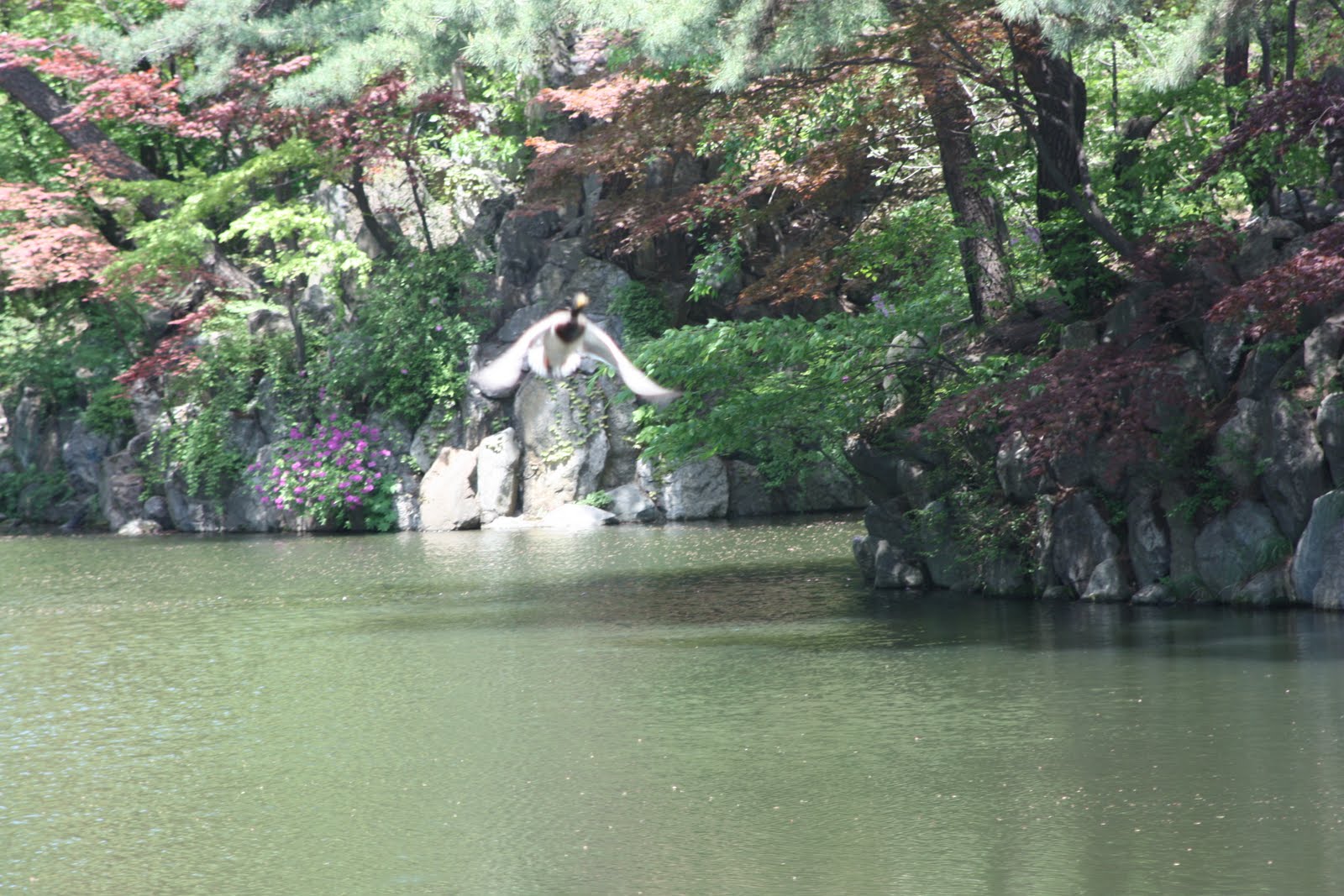
I took this pic in Kyunghee University Campus where I studied Korean Language. I didn't know that the bird is flying towards me, have I known this I could have been focus well with the zooms...
Still I love this pic, cos accidentally I captured this moment so well..and I endure it !


The devilish red Algeria flowers blooming so freely

Kunghee University Campus

Algeria flowers in White and Pink Color

These are my yester years memories I had been spending at Korea and I am still cherishing all these beautiful scenic views..there are more pics in my treasure, I will share here again...
Friday, April 1, 2011
Korea Introduce the world of natural dyes
This is real! The world of natural dyes
On January 11, Maronie exhibition in Kyoto.
Gyeongnam Natural Dyeing Association in Korea held a six-day exhibition in Kyoto which is said to be a city of vivid traditional culture of Japan. Nine members of Gyeongnam Natural Dyeing Association introduced various kinds of natural dyeing products that were made with passion, which received favorite comments from not only Japanese but also the same industry. Let’s take a closer look at this globally recognized and beautiful field of natural dyeing.

< Gyeongbuk Natural Dyeing Association declared that it will become a Mecca of the natural dyeing after hosting ‘Symposium for the Vitalization of the Natural dyeing Industry’ last June.> (Photograph: Fashion Journal)
Natural dyes, the solution of Health and environment
In the Three Kingdom period, while the kings and nobles wore the silk costumes which were imported from China, commoners began to dress themselves with the naturally-dyed clothes. At the beginning, they used grass and polygonum indigo from mountains and fields for navy, persimmon for dark blue, and charcoal for black. In other words, Korean ancestors wear the nature colored clothes, which are different from the recent clothes with unnatural colors made of the artificial fibers and chemical compounds.
Actually, the naturally-dyed clothes do good to skin. Some clothes with chemical dyes cause an atopic dermatitis or other skin diseases to some children who have a delicate skin. However, considering the fact that natural dyes from vegetables are harmless to human and kill the harmful virus, it can be said that clothes save our health.
While the chemical dyes cause serious environmental problems with waste water in dyeing process, natural dyes reduce those damage, which can be said an environmental-friendly dyeing method. In addition, if we make clothes with natural dyes which are extracted from the plants that have unique ingredients or smells to protect them from the harmful insects or animals, it will also protect your body from those. As an example, some ancestors used polygonum indigo as a dyeing material from their knowledge that snakes dislike its smell. Their wisdom of life is just amazing!

< Exhibition of Gyeongnam Natural Dyeing Association in Kyoto. Muffler(left) by Lee Kyung-ran, representative and printed scarf by You Chang-ho, the chairman of the association> (Photograph: Fashion Journal)
Despite the time and hard work, considered a ‘Must Try’ among foreigners
Then, what is the process of making such a wonderful natural dye? The beautiful naturally-dyed cloth can be born only after passing through the 20 manual labor steps, such as boiling, drying, and adding mordant in it. Mordant is an ingredient which helps the color last longer. As it requires a long time and hard work, accordingly the costs rise and become more expensive than the artificial colored-one.
However, as the public interests on environmentally-friendly products increase, the ideas on those products are also rapidly changing. In particular, the experiencing event of natural-dyeing became very popular among foreigners. Moreover, many naturally-dyed clothes are being sold in Jongro area, including Insadong, where foreign visitors mostly visit, and the number of foreigners who come and try the events from a word of mouth also increases. It is said that every single Japanese tourist who is said to have a lot interests on beauty are also impressed with Korea’s naturally-dyed products. It shows that natural dyeing can be worth being one of the representative brands in Korea. That seems enough to enter the global market, considering the Kyoto exhibition which introduced naturally-dyed products at the first on the list.

Korean central government and local government which early saw the potentials have prepared the systematic supporting plan to step forward. Since when the natural dyeing industry was selected by the Ministry of Knowledge Economy as a nurturing business of the local government’s laboratory last 2008, the government finished the preparation to make Gyeongnam Natural Dyeing Association as a core center for natural dyeing industry, and now they are working on it for the development of the field. On the following, ‘Symposium for the Vitalization of the Natural dyeing Industry’ was held in June 2011, and the MOU with Daegu and Gyeongbuk fabric fashion Institute was embedded as well, which actively promotes the natural dyeing industry.

Indigo and dark blue, those colors make people relaxed. If we wear the naturally-dyed clothes, we can definitely say it is a well-being life. Now we all hope that Korea’s naturally-dyed products will actively pushing the overseas markets.
On January 11, Maronie exhibition in Kyoto.
Gyeongnam Natural Dyeing Association in Korea held a six-day exhibition in Kyoto which is said to be a city of vivid traditional culture of Japan. Nine members of Gyeongnam Natural Dyeing Association introduced various kinds of natural dyeing products that were made with passion, which received favorite comments from not only Japanese but also the same industry. Let’s take a closer look at this globally recognized and beautiful field of natural dyeing.

< Gyeongbuk Natural Dyeing Association declared that it will become a Mecca of the natural dyeing after hosting ‘Symposium for the Vitalization of the Natural dyeing Industry’ last June.> (Photograph: Fashion Journal)
Natural dyes, the solution of Health and environment
In the Three Kingdom period, while the kings and nobles wore the silk costumes which were imported from China, commoners began to dress themselves with the naturally-dyed clothes. At the beginning, they used grass and polygonum indigo from mountains and fields for navy, persimmon for dark blue, and charcoal for black. In other words, Korean ancestors wear the nature colored clothes, which are different from the recent clothes with unnatural colors made of the artificial fibers and chemical compounds.
Actually, the naturally-dyed clothes do good to skin. Some clothes with chemical dyes cause an atopic dermatitis or other skin diseases to some children who have a delicate skin. However, considering the fact that natural dyes from vegetables are harmless to human and kill the harmful virus, it can be said that clothes save our health.
While the chemical dyes cause serious environmental problems with waste water in dyeing process, natural dyes reduce those damage, which can be said an environmental-friendly dyeing method. In addition, if we make clothes with natural dyes which are extracted from the plants that have unique ingredients or smells to protect them from the harmful insects or animals, it will also protect your body from those. As an example, some ancestors used polygonum indigo as a dyeing material from their knowledge that snakes dislike its smell. Their wisdom of life is just amazing!

< Exhibition of Gyeongnam Natural Dyeing Association in Kyoto. Muffler(left) by Lee Kyung-ran, representative and printed scarf by You Chang-ho, the chairman of the association> (Photograph: Fashion Journal)
Despite the time and hard work, considered a ‘Must Try’ among foreigners
Then, what is the process of making such a wonderful natural dye? The beautiful naturally-dyed cloth can be born only after passing through the 20 manual labor steps, such as boiling, drying, and adding mordant in it. Mordant is an ingredient which helps the color last longer. As it requires a long time and hard work, accordingly the costs rise and become more expensive than the artificial colored-one.
However, as the public interests on environmentally-friendly products increase, the ideas on those products are also rapidly changing. In particular, the experiencing event of natural-dyeing became very popular among foreigners. Moreover, many naturally-dyed clothes are being sold in Jongro area, including Insadong, where foreign visitors mostly visit, and the number of foreigners who come and try the events from a word of mouth also increases. It is said that every single Japanese tourist who is said to have a lot interests on beauty are also impressed with Korea’s naturally-dyed products. It shows that natural dyeing can be worth being one of the representative brands in Korea. That seems enough to enter the global market, considering the Kyoto exhibition which introduced naturally-dyed products at the first on the list.

Korean central government and local government which early saw the potentials have prepared the systematic supporting plan to step forward. Since when the natural dyeing industry was selected by the Ministry of Knowledge Economy as a nurturing business of the local government’s laboratory last 2008, the government finished the preparation to make Gyeongnam Natural Dyeing Association as a core center for natural dyeing industry, and now they are working on it for the development of the field. On the following, ‘Symposium for the Vitalization of the Natural dyeing Industry’ was held in June 2011, and the MOU with Daegu and Gyeongbuk fabric fashion Institute was embedded as well, which actively promotes the natural dyeing industry.

Indigo and dark blue, those colors make people relaxed. If we wear the naturally-dyed clothes, we can definitely say it is a well-being life. Now we all hope that Korea’s naturally-dyed products will actively pushing the overseas markets.
Subscribe to:
Posts (Atom)