Friday, March 23, 2012

Renowned travelogue marked record sales

Yoo Hong-jun’s renowned travelogue series has sold 3 million copies, according to its publisher Changbi. The six-part series is the only humanities publication to hit the 3 million mark.


“As of March, several humanities books have sold over 1 million copies, like “What is Justice” or “Youth Hurts.” But the travelogue is the first in the category to sell over 3 million,” the publisher said in a statement

“My Survey of Cultural Heritages” has made the author one of the most recognizable experts in this area.
No scholar in modern times has been able to write such detailed, enlightening, and at times entertaining, stories on cultural heritage across the Korean Peninsula. Of the six books, two of them are devoted to stories solely on cultural treasures in North Korea.
Yoo also served as the head of the Cultural Heritage Administration of Korea from 2004 until 2008. He currently serves as a professor in the Art History Department at Myongji University.

An art historian by profession, he released the first part of the series in 1993, centered on his personal experiences of traveling through the southern part of the country.

The main purpose of the travelogue has been to shed light on numerous unrecognized cultural artifacts all over the Korean Peninsula.

The first of the series became an instant bestseller, contributing to a new sense of respect among the general readership of our own cultural heritage.

‘To love is to know’

The 63-year-old tried to engage the public in learning about our traditional legacy through famous quotes like “To love is to know” and “We can only see as much as we know” found in the first series.

The sixth book was released last year, devoted to Seoul and areas that he had neglected to cover previously, like South Chungcheong Province.

He devotes almost 150 pages to Gyeongbok Palace alone, giving readers fresh, detailed insight into the Joseon Kingdom (1392-1910) landmark.

The sub-title of this latest series can be translated as “There Are Hidden Masters Everywhere,” which is a reminder to readers of the hard work of numerous experts and masters in maintaining cultural heritages, including temples, hanok (traditional Korean houses), old schools, palaces, museums, parks and much more.

“A masterpiece is the outcome of the strenuous efforts of many hidden masters. Though unrecognized by the public, they are the true experts,” Yoo wrote in the introduction of the sixth series.

A seventh series will be published in June, with a focus on introducing the traditional treasures of Jeju Island.

There is no telling when the series will be concluded, as he said many parts of the Korean Peninsula still remained uncovered.

“I would like to also write about North Chungcheong and Gyeonggi Province. If I get a chance to visit some more North Korean cities like Hamheung, Bukcheong and Gapsan, I would like to do an additional book on North Korea,” Yoo said.

He also expressed a wish to someday write about the Korean cultural legacies housed in countries like Japan and China.

Boston museum to boost Korean gallery

The Museum of Fine Arts (MFA) in Boston will renovate its Korean gallery starting this month. The refurbished space, to reopen on Nov. 15, will have white walls and recreate a Korean traditional oiled paper floor. Paintings, screens, and ceramics pieces will be shown in new high-end display cases.

Originally built in 1982, the gallery houses works from over 1,000 items in MFA’s Korean collection. “Our Korean collection really formed from the very beginning of the museum,” Malcolm Rogers, director of MFA, told The Korea Times after his lecture on Thursday.

Rogers came to Korea to speak about MFA’s global outreach programs at a forum hosted by the Korea Foundation. Jane Portal, the Matsutaro Shoriki chair for the Art of Asia, Oceania, and Africa at MFA, accompanied him for the occasion.


Considered as one of the finest in the West, MFA’s Asian art collection started when three men from Boston traveled to Japan in the late 18th century and brought back Buddhist paintings. Among them were pieces from the Goryeo Kingdom (936-1332) and Joseon Kingdom (1392-1910). The collection also accrued porcelains and ceramics that Chareles Bain Hoyt, a railroad heir, donated in 1950.

Portal who oversees the Asian collection has been acquiring screens and contemporary ceramic creations. “People are familiar with Japanese screens but Korean works are not so well known. I wanted to show that Korea also produced screens,” she said. By displaying works of modern day potters such as Shin Sang-ho and Lee Eun-jin, Portal hopes to show how they have transformed the traditional techniques.

“Portal is an expert and well connected, but we don’t have a curator in Korean art yet. We’d love to receive funding for that one day,” said Rogers. The museum which had about 1.2 million visitors last year, funds itself through three channels — endowment, fundraising and admission. The museum has about 80,000 members who pay annual subscription fees. The budget for this year is $75 million.

The government contributes by making gifts deductible, which gives donors tax breaks.

Having served as deputy director and deputy keeper at the National Portrait Gallery in London, he explains the difference in the funding system between the two countries affects the public’s attitude. In Britain, the government supports museums and as a result, the general admissions are often free. “I think it makes the public take you (museums) for granted, where as in America, people feel that they are acquiring something of value if they are paying.”

Surrounded by schools like Harvard, MIT and Boston University, MFA is developing programs to reach students. Last year’s College Night, an annual event that invites faculty members and students free of charge to enjoy shows, drinks and music at the museum, attracted 6,000 visitors.

The Massachusetts schools pay annual fees to allow their students to visit the museum for free. The subscription fee varies with the size of the student body. Recently, private philanthropies from New Hampshire and Maine offered to organize funds. This will allow students from the states to visit the museum for free as well.

MFA also fosters a group of young professionals to be the leaders of their society. Members of the Art Council learn about art collecting, meet donators and attend various functions.

Since he took the position in 1994, Rogers has strived to make the institution more accessible. He extended the museum’s opening hours in 1995; MFA is now open seven days a week. “I believe museums exist for people.” He has also been focusing on globalization. In 1999, Rogers helped launch the Nagoya/Boston Museum of Fine Arts in Nagoya, Japan.

“MFA is encyclopedic; we really try to represent world culture in all times.”

Ganghwa peace observatory centre


“The memory of crossing the Han River on a wooden raft 60 years ago, it’s still so vivid in my mind. I came with my parents and my sister had just gotten married the day before the Korean War broke out. We still haven’t heard from her since,” said Choi Sun-nam, 74, as his eyes filled with tears.

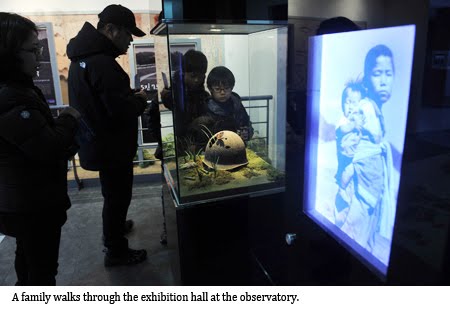
Choi was at the Ganghwa Peace Observatory, casting longing looks toward North Korea. The observatory is located in Cheolsan-ri, Ganghwa County, in the northernmost part of Incheon, a port city about 40 kilometers west of Seoul. It’s where the residents of Yeonbaek Plains in Hwanghae Province mostly settled after fleeing the 1950-1953 Korean War. At the observatory, former North Korean residents like Choi can often be spotted. About 220,000 former North Korean residents visited the spot last year.

From the observatory that opened in 2008, North Korea is only 2.3 kilometers away while the Gaeseong Industrial complex is about 17 kilometers from it. To its left are the Yeonbaek Plains and to the right, one can see glimpses of Gaepung County in North Korea.


The observatory is on three floors. On the first floor is a shop selling local goods from Ganghwa as well as North Korean items and restaurant and a “unification-wish” room. The second floor houses an indoor observatory and an exhibition hall. On the third floor is the observatory, which is equipped with high-tech telescopes to allow a closer view into the North. Outside there is a stand where the visitors can pay respects to the families they have left behind and a musical box where you can push a button to hear a song about the scenic Mt. Geumgang in North Korea.


The observatory is open throughout the year, with seven presentations a day on its history held there. For more information, visit www.ghss.or.kr, or call 032) 930-7062.


Thursday, March 22, 2012

When tigers smoked


It is hard to say with any degree when cigarettes were first introduced into Korea. Early encounters with the crews of Western ships may have led to the exchange of cigarettes as gifts but more than likely the introduction of cigarettes began after the Treaty of Ganghwa (The Japan-Korea Treaty of Amity) in 1876.

At first, cigarettes were not very popular ― especially with the common people ― as they were difficult to obtain and quite expensive. In 1882, a small group of American naval officers aboard a Japanese merchant ship managed to sneak ashore at Fusan (modern Busan) for a quick but forbidden visit of that port. They noted that pipe smoking was prevalent amongst the people and that some Koreans smoked cigars of crudely rolled-up tobacco leaves.

In 1883, shortly after Korea opened to the West, an attempt was made to export cigars made from Korean tobacco into the foreign markets. A British diplomat noted that “the cigars which have been turned out on the first attempt are well made and of good tobacco.” However, this initial attempt apparently failed as there is no mention of tobacco being exported in the Reports on Trade.


Western cigarettes, at least in the palace, quickly became popular. In 1888, an American journalist visited the palace and wrote:

“The queen dresses, of course, in Korean costume. She wears fine silks and she has beautiful diamonds. She carries a chatelaine watch which is diamond studded and she smokes American cigarettes by the thousand. All Korean women smoke and the majority of them smoke pipes. The country is, in fact, a land of smokers and the boys and men are seldom seen without pipes in their mouths.”

As cigarettes became more available their prices dropped and their popularity with the common people grew. This led some unscrupulous merchants to try and make a quick profit by packing the once used boxes of American and British tobacco companies with inferior cigarettes. Horace Allen, the American Minister to Korea, urged the Korean government to punish the Koreans involved and was surprised to learn that the Korean Government offenders would be punished with death. Allen noted that the restrictions were effective against the Korean offenders but did nothing against “the Japanese merchants who were the chief offenders.”

The popularity of cigarettes also led to some enterprising Korean entrepreneurs to start their own company. In 1898, The Independent (an English-language newspaper in Seoul) reported:

“Enterprising spirit is slowly but surely permeating the hearts of Koreans. One of the latest indications of it is that a Korean company has been formed to manufacture cigars in Songdo and Seoul with Koksan tobacco. Koksan is a mountainous district in Whanghai and produces a considerable quantity of tobacco….The company ships on the average 10,000 cigars daily to various cities in the country and the demand is said to be increasing. They burn fairly well and considering the price (which is 34 cents per 100) it is a reasonably good smoke.”

The Koreans weren’t the only ones to take advantage of the growing market. By 1903 there were at least two foreign cigarette factories in Chemulpo but even they were not able to keep up with the growing demand.

A review of the customs reports indicate that 92,661,000 cigarettes were imported into Jemulpo in 1903. This number grew to 493,087,000 in 1904 ― undoubtedly due to the start of the Russo-Japanese War and the large number of Japanese soldiers in Korea. Even after the war, more than 395 million were imported.

According to one customs agent, the large import “shows clearly how cigarette smoking is growing in favor with the Koreans and displacing, at least among the working class, the cumbrous long pipe of former days.”

Source: The Korea Times (Arts and Living Section)

Korea Foundation :Lectures on local films for foreigners

The Korea Foundation will be holding a series of six lectures on Korean films starting from comming Monday. This opportunity will give an ample insight to the film lovers as well as to the foreigners who are in Korea.

“Open Lectures on Korean Culture for Foreigners: Treasures of Korean Cinema” will introduce local movies produced between 1958 and 2001 at the Culture Center of the foundation at Mirae Asset CENTER1 Building West Tower, Suha-dong, Seoul. Offered in English, this is an opportunity for foreigners to get an overview of the local scene.

Earl Jackson, a former visiting professor at the School of Film, TV & Multimedia of Korea National University of Arts, will teach the two-hour lectures. Jackson will give brief introductions to the films and watch them with the participants.

“The power of the Korean film industry to portray diverse lives with a fraction of the budget for Hollywood blockbusters like Titanic stems from the creativity that was impacted by the Japanese occupation and the Korean War,” he said. Jackson received bachelor’s and master’s degrees in comparative literature from Cornell University and Princeton University respectively.

The series will kick off with Yu Hyun-mok’s “Obaltan” (1961). Based on a novella of the same name by Yi Beom-seon, it captures the struggles of a Northern Korean refugee family living in Seoul in the late 1950s. It was banned shortly after its release for its grim portrayal of post-war Korea, but subsequently praised for its bold camera techniques and its own form of realism.

On April 9, the class will view “Flower in Hell” (1958) by Shing Sang-ok that follows a prostitute who works around an U.S. army bases in the 1950s. The list of films includes Hanyo (April 23) Mist (May 7) and Holiday (May 21) and One Fine Spring Day (June 4)

This is the second lecture series on Korean film at the Korea Foundation; In September 2011, the institute introduced productions from the 1950s and ‘60s.

Monday, March 19, 2012

'Dansaekhwa' shows timeless movement


Not one of 150 paintings at “Dansaekhwa; Korean Monochrome Painting” at the National Museum of Contemporary Art fails to overwhelm the viewer both in scale and rigor.

Choi Byung-so filled in newspaper pages with ballpoint pen and pencil until the paper turned completely black and shiny with charcoal and ink. Kim Tae-ho’s over-two-meter-high paintings consist of numerous grids; Kim repeated layering up and chipping off the dried ink until the acrylic results protruded over three centimeters off the wall.

“The unique feature of Korean ‘dansaekhwa’ (monochrome paintings) is that they stimulate the tactile sense,” explained Yoon Jin-sup, professor at Honam University who was invited to curate this show, at a press conference at the museum Thursday. This large-scale exhibition convenes works of 31 artists who have pursued a specific genre of abstraction since the 1970s including Kim Whan-ki, Lee U-fan, and Park Seo-bo.

Though labeled monochrome paintings, these works defer from the blue paintings of French artist Yves Klein. This school is devoted to the process or repetition and specificity of material not necessarily to a color. “The repetition we see is a type of searching for neutrality and transcendence.” Kim, in his last years in New York, produced wall-size paintings of squares (“Where, in What Form, Shall We Meet Again,” “Echo 19-II-73 #307”), while Lee Bae mounted blocks of charcoal on canvas (“Issue on Fire,” “Landscape 2000-1”).


These characteristics led the curator to use the Korean term in the English title instead of simply translating it into monochrome paintings.

Lee Kang-so, whose mural-size acrylic works “From an Island” and “Emptiness” are on show, emphasized the historical significance of the exhibition. “We do not need to lament that the masterpieces from the ‘70s only came together now. What is striking is the similarity in these works. The undercurrent of self-control and abstraction was flowing through the Korean artists.”

To help the visitors understand the movement, the museum in Gwachon, south of Seoul, complied over 300 texts on dansaekwha as well as interviews with surviving artists.

Lee U-fan lecture

World renowned artist and philosopher Lee U-fan gave a talk on the art scene in 1970s – when the dansaekwha style bloomed at the peak of the nation’s military dictatorship – at the museum as part of its educational program on Saturday.

“The reality for Korean artists at the time was an abstraction itself,” Lee stressed “They were experiencing dire poverty; they were struggling to secure canvas, paper, or paint to work with.”

According to Lee, the works on display embody resistance against the military regime at the time, refuting the popular criticism in the 1980s that these abstractionists were turning a blind eye to social issues. “You don’t have to paint a fist to challenge authority; it is only natural that the mode of fighting was to devote oneself to the abstract, to deny the unreal reality.”

The repetition, crucial feature of these works, defies any meaning and the subdued hues refuse to take on recognizable color. “These artists were also voicing their opinions with this style. The offerings here are more energetic and righteous than those of any other era,” he said.

In the post-World War II era, artists around the globe were seeking change. In Italy the radical experimentalism of Arte Povera took place while American artists started to incorporate natural surroundings to their works and started the Earth Art movement. In Japan, Mono-ha, a school of artists who investigated found objects and natural materials, came to prominence. Lee, who developed his artistic career in the island nation, is considered one of the leaders of the movement.

The exhibition runs through May 13. Visiting curator Yoon’s lecture on the exhibition is on March 24. Visitors can register online for a tour to Lee Kang-so’s studio in Ansan, Gyeonggi Province on March 31. Park Seo-bo will give a talk on Korean contemporary art on April 14 at the museum.

For more information, call (02) 2188-6000 or visit www.moca.go.kr.

Sunday, March 18, 2012

In Korean Movies Multiculturalism is the new theme

More and more Korean movies, including "Pacemaker" by director Kim Dal-joong that opens next Thursday, are taking on the theme of multiculturalism that is changing the face of Korean society. In 2010, one out of every 10 marriages involved a foreign spouse, while the number of children from multicultural families has grown seven-fold from 25,000 in 2006 to 160,000 in 2010. And this trend is being portrayed more frequently on the silver screen.

It was TV dramas that first dealt with the issue. The SBS dramas "Hanoi Bride" (2005) and "Golden Bride" (2007) featured a Korean man who married a Vietnamese woman. But the main focus of those soaps was mostly about the love between a man and a woman that transcended borders. They avoided dealing with the complex issues facing multicultural families. However, recent movies have shown more interest in depicting how families from different social and cultural backgrounds manage in Korean society.


Shin Dong-il's "Bandhobi" (2009) and "Banga Banga" (2010) by director Yuk Sang-hyo drew a lot of attention due to their candid portrayal of the mistreatment of foreign laborers, which has become a more prominent social issue in the country.

"Bandhobi" focuses on the friendship between a Bangladeshi laborer and a high school student, while "Banga Banga" concerns a young unemployed Korean who finds work posing as a foreign laborer. The latter was a low-budget film that cost just W800 million (US$1=W1,159) to produce, but became a box-office hit that attracted over one million viewers.


Lee Han's "Punch," which opened last October, seriously highlighted the issue of multicultural families. But no one expected the movie about a boy with a hunchback father and an immigrant mother from the Philippines to turn into a box office hit, drawing over five million viewers.

In the film, there are several other minor characters who show the daily routines and realities of migrated workers in Korea.

"This movie not only reflects the changes happening in our society, but also tries to suggest solutions," said movie critic Jeon Chan-il. "Rather than adopting a patronizing approach to impoverished foreign laborers who come to Korea to make money, the movie makes us realize they are a part of our society."

One filmmaker said, "We cannot avoid multicultural families and foreign laborers as they have become so common these days." He added, "These changes have been taking place for some time now, so moviegoers are not unfamiliar with this subject. We will probably see more movies taking on this issue."