Friday, March 9, 2012

Korean Date 14th : get fever on 14th April or high on 14th March

All things bright and beautiful when we start falling in love. Date 14th of every month in Korea has a special day, starting from the first month of the year itself.But you know, this month i,e March 14th is more special from the resst of other month 14th.

Yes it is so special for women and well as for lovers or couple than the Valentine day which fall on 14th of Frebruary. Because women are pampared by their lovers with flowers, chocolates anything which symbolise the meaning of love.


Initially, I find it funny and strange about this unique culture
of Korea. Because in most of the countries what we hear about is people celebrating Valentine's day. Again shocking thing for me is that on Valentine's day women give chocolates to their men and confess their love which is contrast from other countries.


January 14th – Diary Day
Couples are meant to give each other a diary or year planner thing, and note down all the rest of these lovely gift-giving days.


February 14th – Valentine’s Day


In contrast to Western society,in Korea today is traditionally when women give chocolates to their men and confess their love.


March 14th – White Day


Men give candy to the women they love (and flowers and choc and cuddly toys….in fact, anything really!)


April 14th – Black Day


A purely Korean day, for those singletons out there, who havnt received choc or candy so far, console yourselves by eating ja jang myung – a black noodle soup – or other black foods.


May 14th – Rose Day or Yellow Day


Couples exchange roses, and those lonely hearts gather for curry and companionship. Apparently dressing in yellow is also recommended.

June 14th – Kiss Day
As one site puts it: Lovers confess their feelings to one another and kiss passionately.

July 14th – Silver Day
I’m liking this idea – couples can freely ask their friends to give them money to pay for a date. Couples exchange gifts made of silver, and announce their relationship to their friends.

August 14th – Green Day
Couples are supposedly dress in green colors, and walk around the woods (the only day to go and get green green or to get camouflage opportunity)
And those who are singles, they go for a drink a bottle of soju to console themselves.

September 14th – Photo & Music Day
You know on this very day, Couples take photographs together, then in the evening go out with friends to noraebangs maning song-room and night clubs.

Well here some fluctuation on the month of October and November, as on October instead of 14th they have Apple day on 24th. On November , our very own irresistable snacks Papero day on 11th of November.

(October 24th – Apple Day)


Are you ready to learn something? The Korean word for apple, Sa-kwa or Sa-gwa, also means to apologize. On Apple Day, friends, family and couples give an apple to each other to apologize for their past mistakes which they did unknowingly or with intension.

November 11th – Pepero Day (Ah yes, the choco stick day the day when boys use to gift basketfull of green or red color chocolate coted stick.)


A new day that has taken off in South Korea which was started from Japan, it is named after a long stick-shaped cookie stick covered in chocolate, given mostly by young Koreans as an expression of their affection.Once, I got bunch of green color pepero boxes from my Korean freinds.


The 11th day of the 11th month is specifically chosen as the number looks like a Pepero stick. Students exchange the treats with one another with the thought of growing tall and thin.

November 14th – Movie Day & Orange Day


Ok, Well from family to lover or couples go for movies and eat oranges as thir snacks of the day .

December 14th – Hug Day
Iget hugged last time , when I was at Korea. Actually, people in Seoul giving out free hugs at this time.Freinds hug each other to tighten their freindship and the couples are meant to hug one another lovingly to stay cosy in the cold winter months.

Do you know: Early Joseon bar room brawls

In the late 19th century, Jemulpo (modern Incheon), the main port of Korea, was an international city filled with merchants, traders, sailors from warships and steamers and various indigent riffraff looking for “a situation” (employment). Catering to this large transient population of men was a number of hotels and taverns that provided not only lodging but strong drink.

One of the most popular hotels in the late 1880s and early 1890s was Hotel de Coree. Isaak Kamerling Steinbeck, the owner of the establishment, was one of the earliest Austrians to live and do business in Korea. An early visitor provides insight into

why his hotel was so popular:

Hotel de Coree is “a favorite resort for sailors of men-of-war when they called at that port, partly because a drinking saloon, well provided with intoxicants of all descriptions, was the chief feature of the establishment, and partly because glasses were handed over the counter by a very fascinating young lady, daughter of the proprietor, a most accomplished damsel, who could speak fluently every language under the sun — from Turkish and Arabic to Corean and Japanese.”


But drinks and conversation weren’t the only things these drinking establishments offered. Card games and pool tables provided the men with entertainment and some even provided female companionship.

Of course, with so many men drinking in such a confined area there was bound to be trouble. In December 1886, Walter Laws, an African-American described as “destitute,” was involved in an altercation at the Daibutsu Hotel — a Japanese-owned establishment.

Laws was drinking with a friend at a table and made a disparaging comment about the Chinese. According to Laws, a Chinese man overheard the comment and “felt aggrieved and dared me to repeat. I repeated it, he shoved me, I struck him. Feeling ashamed at the result of my hasty action, I apologized. He refused to accept the apology and caused me to be arrested.”

Laws was apprehended by the Chinese police and then — some twenty-two hours later — turned over to Commander Selfridge of the U.S.S. Omaha, an American warship.

A Japanese newspaper claimed that Laws had “committed a brutal and unprovoked assault on a peaceable Chinese storekeeper” and was part of the riffraff that had been dispelled from Nagasaki. Selfridge, however, felt that Laws was an “inoffensive young man” and the incident was nothing more than “a simple case of assault.”

But not all the incidents were so simple.

On Nov. 19, 1899, Frederick W. Richmond, a 23-year-old Canadian, met an “untimely and shocking death” after being involved in an altercation in a small hotel. Richmond was a relatively newcomer to Korea and had served in Tientsin (or Tianjin), China as a bandmaster before coming to Jemulpo to begin a new career as a member of the Korean Imperial Customs Service.

On the evening of his death, Richmond was in the Ryan Hotel with a friend when he apparently exchanged some harsh words with Cambas, a passenger aboard the Russian steamship Sungari. At about 6:30 p.m., Richmond left the hotel alone — possibly returning home — and “was found at 7 o’clock in an alleyway quite dead, with several wounds on the head and neck, supposed to be inflicted by a dagger.”

Almost immediately suspicion fell upon Cambas but the suspected murderer managed to get aboard his steamship as it departed and, judging from the lack of information, made good his escape.

Richmond was buried three days later; his grave — like many at the Jemulpo Foreigner’s Cemetery — unvisited and forgotten.

Tuesday, March 6, 2012

'Shinhwa' Korea's longest-running boy band

Korea's popular K-pop group "Shinhwa" said recently, wants to remain the country's longest-running "boy band" as it announced plans for a new album and concerts after four years away from the stage.

Clad in sharp black suits, the six members of the group expressed their excitement at a news conference in Seoul to mark their 14th anniversary and upcoming Asian tour.

"I feel really great and thankful about coming back to the stage," Eric, the group's leader, told reporters. He is also chief executive of the Shinhwa Company, an entertainment agency set up by the group. "We will become a group that stays in the center of the pop musical world for a long time in the future, not ending with our 14th anniversary," he said.

He expressed special thanks to Lee Soo-man, a singer and head of SM Entertainment, for having "six boys of naught" gather under the name Shinhwa, and also the group's fans for their consistent support.

After making its local debut in March 1998, Shinhwa and another boy band "H.O.T," which has since disbanded, enjoyed huge popularity through the late 1990s.

Shinhwa took a break from group activities for the past four years since its last concert in 2008 to celebrate the 10th anniversary of the band's debut, as members fulfilled their mandatory service in the military. While on hiatus, the individual members have worked as television and musical actors, solo vocalists and television entertainers.

Vocalist Lee Min-woo recently completed his military service and the group is expected to release its 10th regular album later this month.

Kim Dong-wan, another vocalist, said there was no secret to the group's longevity, but simply luck.

"Some groups separate after their members fight but, fortunately, such things became chances to bring us together more tightly," he explained.

The group said they will try "to be more like themselves" rather than change their style to compete with a recent flood of K-pop groups.

"We want to show that being old does not always mean being a step behind and that a masterpiece is not made in a day," Eric said.

Shinhwa will mark its comeback and 14th anniversary with concerts at Seoul's Olympic Park on March 24 and 25. Tickets for the concerts were sold out within 40 minutes of going on sale, according to the agency.

After the Seoul concerts, the group will begin an Asian tour that will take it to Shanghai, Taiwan, Guangzhou, Tokyo, Kobe and Beijing until early July. (Yonhap)

Ornaments of Meitei

This blog of mine is entirely written for Korea and Korean culture to promote. People are appreciating it. I am so delighted to see the warm embrace and their support. Taking this opportunity I would like to introduce the Meitei clan or community where I belong. A small community which are confine in the extreme corner of the North-East bordering with Myanmar (Burma). Here I am showcasing some of the rare ornaments which The Meitei women only wear from the time immemorial .


We the women always been blessed by charm and grace. But in addition with these grace and charm, gold and daimonds made their place in every women's heart. We make their space in such a manner that women cannot live without ornamental.


The aura of every Meitei women


Meitei women do have their own unique ornaments since the time immemorial. Time to time fashion keeps on changing but these beautiul jwelaries never got out of sight. In a way these are compulsion for the Meitei women to wear in every ocassion specially on marriage.


Monday, March 5, 2012

‘Podaegi’ Korean baby sling: emerging as new generation mom’s must-have in

Have you heard about the word PODAEGI ? If yes , then what comes into your mind when you think of the traditional Korean baby carrier “Podaegi?” Dull, outdated or just plain ugly stuff ? Then you haven’t seen the upgraded baby sling that just got a makeover far from home.


Many Hollywood celebrities like Gwen Stefani, Julia Roberts and Courtney Cox are among many leading the new trend by cradling their babies Korean style.Hollywood stars are just in love with podaegi, or Korean-style baby carriers!


Photo Source: organiclifelove.com/google image


Celebrities are not the only fans, either. Podaegi is, in fact, causing a hype among mothers around worldwide. Even many Video clips are on the internet show the great popularity of podaegi around the world. Some users even give instructions/demonstration on how to use it.


So what is this Podaegi?


Photo Source: hancinema.net/google image


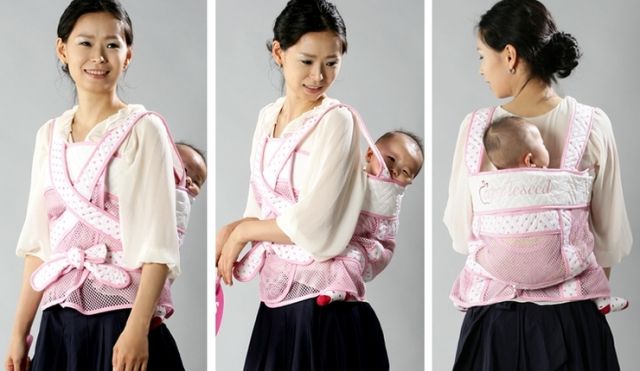
A podaegi(Korean: 포대기, also spelled podegi), is a wrap-a-round blanket with straps. It is a baby carrier that has been used in Korea for over many decades.
This traditional Korean baby carrier blanket is called podaegi, kind of hit among young hipster parents in the U.S. and other countries.


The podaegi is a Korean carrier with a medium to large rectangle of fabric hanging from a very long strap. Traditionally the rectangle is quilted for warmth and wraps around the mother's torso, while the straps are wrapped snug under the baby's bottom and tied around to the front to support and secure the baby on the mother's back. Western interest in the podaegi style has led to new wrapping methods which do go over the shoulders, and to narrower "blankets".


Photo Source: Wikipidia/google image


A Google search for podaegi shows mothers around the world using it to carry their baby. The website introduces it as a traditional Korean form of carrying babies close to a parent's body. It adds that podaegi "can be tied around the adult and baby" with the straps attached and "it's a perfect fit with every tie, resulting in superior carrying comfort for both mom and baby!"

Podaegi are also being sold on many other websites too including Cotton Cradles trading baby carriers of natural fabric. A search for podaegi on Google and other international portal sites leads to content uploaded by people who created their own podaegi along with photos or video clips of mothers carrying their babies in one.

File photos of Women wearing Podaegi in Korea circa 1945 and 1960


Photo Source: Both the pictures are from Flickers.com


Podaegi has actually existed for centuries, as Korea's traditional way of carrying babies.Many people, however, looked down on podaegi as being backward and unsophisticated but now a days it is regaining attention in Korea and other countries too.


According to Kwak Keum-joo, Professor of psychology Seoul National University: "Babies experience great anxiety after being born. Being wrapped in a podaegi, however, allows them to listen to their mothers' heartbeat and feel close to them. This helps them restore the emotional stability that they once had in their mothers' uterus".


Photo Source: hancinema.net/google image


Various Advantages of using Podaegi:

Podaegi also facilitates the interaction between the mother and her baby.How comfortable is podaegi compared to baby slings ... First, it holds them tightly,and makes it easier for the mother to work more efficiently.

During the 9 months of pregnancy, babies are surrounded by warm amniotic fluid and stay in close contact with their mothers' heartbeat.Podaegi effectively reproduces this environment.

According to the mothers who have been using Podaegi said the greatest advantage is the entailed intimacy between mother and her baby.For some mother it is absolutely essential for people who have a baby in their households. You could use baby slings instead, but podaegi is more comfortable, and the baby likes it better, too. That's why a lot of people buy it.

That's why mothers around the world can't help but choose podaegi over baby slings.
Podaegi has been a hit among mothers worldwide. Why don't you give a try it yourself to see just why it is so popular

Saturday, March 3, 2012

'Love Fiction' rises on the top


The marketing drive for “Love Fiction” was systematic and fierce. Backed by four of today’s hottest stars in the credits and inflating for more than a month, the hype was ripe. And it was effective, attracting more than 450,000 moviegoers in two days, since its release Wednesday.


But somehow not many seemed to know how to describe the movie even as the buzz continued to spread.

That is because the newest film by Jeon Kye-soo cannot be summarized in a few words. Though much of the promotional material says it is a tale of a timid, clueless flake chasing a gorgeous woman with an eccentric body-grooming custom, it is not as simple as that.

It is a perplexing tribute to love, a brutally honest portrayal of its progressive steps — from courtship to fizzling out. It is a satire of the bachelor social ladder, on top of which sit three-piece suits and white gowns while the rock bottom is occupied by poor artists. It is a story of a writer’s block, which the protagonist hopes to overcome with a muse.

It is a story of the man in its unpasteurized form: that needy, selfish and affection-seeking part of the human male species taking shape as the protagonist Goo Joo-wol (played magnificently by Ha Jung-woo).

He is an author of popular novels, and he cannot seem to start another volume after the first work’s modest success. He needs a muse, he claims, and finds one in Hee-jin, after running into her at a party in Berlin. The relationship is not without hurdles, as the writer confronts Hee-jin’s quirks one by one. She is an unpredictable divorcee who does not shave her armpits. Inspired by the object of his love, he starts a new online series, “Mrs. Armpit Hair.”

“The film’s angle is from a man’s perspective — 100 percent,” said Jeon, Wednesday. “I worked on the film anticipating some negative feedback from women. Kong Hyo-jin (who plays Hee-jin) did have several problems with the story, but I think this (movie) is my response to those concerns.”


Indeed, other female moviegoers who attended advance screenings expressed their discomfort after watching it, flooding the blogosphere with their voices against the quasi-universal praise from the press.

“Reality can be ragged, pathetic and desperate,” said Jeon, adding that he expected the audience to ask why they have to watch that sad truth on the silver screen instead of a fairy tale with a prince charming.

But the result is breathtaking — the two-hour running time never drags — thanks to the compact script, well thought-out pace and Ha’s knockout performance.

It is his first time in a lovey-dovey feature, but he is a natural. Jeon’s first choice from the very beginning — five years ago — Ha is astonishing in his movement. His acting is holistic; he seems to use every controllable muscle in his body, breezes through elongated monologues and fills silences with charisma. His hopeless love is just as convincing as his clumsy attempt at a one-night-stand. He apologizes to Hee-jin’s underarm with startling seriousness. Everything is believable with Ha.

“I find the (name’s) sound important,” said Jeon, explaining the puzzling name of Goo Joo-wol. “It has that sound of a character that steps out the door of his house at around 2 p.m. in his pajamas, loitering about without doing much, like a neighborhood rogue complaining about society.”

The other three, Kong, Ji Jin-hee and Yoo In-na, also are able to play roles that are complete departures from the usual, with hilarious results.

Kong may have a less important, less dynamic part in general but does an adequate job of maintaining that mix of charm and feminine mystery so many men have trouble with while dating.

“The film is hopefully everything that a man can experience in love,” said Jeon, “in two hours” (of running time).

Ji, who plays Goo’s brother, is a perfect antidote to that fool in love, living a life with zero ambition. The actor that embodies refinement above all else is instead wasting away at home doing nothing but eating ramen and watching TV. He is excellent.

Yoo has the least amount of screen time but impresses as Goo’s ex and a character in the cutaway scenes of “Mrs. Armpit Hair,” using overdramatic old-cinema voices.

Jeon said he was inspired by French director Jean-Pierre Jeunet and his 1991 film “Delicatessen” to become a director, and the influences do show. There are also similarities to the fantastical style of fellow Frenchman Cedric Klapisch, of “Auberge Espagnole (2002)” fame.

But he seemed to be refreshingly carefree, modest and confident at the same time.

“I’m just glad I can make a living by making movies.”

Currently in theaters. Runs 121 minutes. Rated 15 and over. Distributed by Next Entertainment World.

Ex-ambassador to lead Korea Foundation

Kim Woo-sang, former ambassador to Australia and respected foreign affairs scholar, has been named the 10th president of the Korea Foundation (KF), the Ministry of Foreign Affairs and Trade announced recently.


He replaces Kim Byung-kook, who will be at the helm of a diplomatic academy, effective immediately.

The KF spokesman said Friday that the date has not yet been fixed for the beginning of Kim’s term, but he is expected to take office in the next week.

Founded in 1991 under the ministry to foster a better and wider understanding of Korean language and culture overseas, the agency had 179 billion won under management at the end of last year.

Previously Kim served in a diplomatic post in Canberra from April 2008 to August 2011. He was also included in the special delegation to the United States when President Lee Myung-bak was president-elect. The academic diplomat has more than two decades of research and teaching in international relations under his belt, starting from the Hoover Institute at Stanford in 1987 and most recently at the Yonsei University’s Institute of East-West Studies before his ambassadorship.